
Lumps, Scabs and Ticks: What Groomers Find Under the Coat
Lillian Ruff Pet Spa

A full brush-out and bath is the most thorough head-to-tail check most dogs get all year. Nobody else puts their hands on every square inch of a dog, twice, under water and under a dryer. Which is why a fair number of grooming appointments end with a groomer saying some version of: there's something here you should have looked at.
If we tell you we felt a lump, a scab or a tick, we are telling you a location and a texture — not a diagnosis. Every finding on this page resolves the same way: your vet looks at it. That is not us dodging. It is the only honest answer a groomer can give.
Why hands-on grooming is the most thorough skin check most dogs get
Think about how a dog is normally touched. Petting concentrates on the head, chest and back. A vet exam is efficient and mostly focused on whatever brought you in. Even attentive owners rarely part the coat behind the elbows, between the toes, under the tail or along the belly seam where the leg meets the body.
Grooming does all of that by necessity. To line-brush a coat you lift it in sections, root to tip, across the whole dog. To bathe properly you work shampoo down to skin. To dry and finish you go back over every section again. Somewhere in that process a groomer's fingertips have covered essentially the entire surface of the dog, slowly, with the coat moved out of the way.
What actually turns up
Most of it is unremarkable. Some of it is worth a phone call. None of it is ours to rank.
Two more come up often enough to be worth naming, even though they are less dramatic:
- Sore spots. A dog that is fine everywhere else and flinches in one place is telling you something. Hips, ears and mouths are the usual three. We note where the reaction was and how strong it was, and that goes to your vet with everything else.
- Embedded debris. Burrs, seed heads, grit, road salt, gum and matted-in dirt. Some of it has been in there long enough to have irritated the skin underneath, which is why we mention it rather than just brushing it out and forgetting it.
Why we describe it and never diagnose it
Groomers are not licensed to practice veterinary medicine, and no amount of experience changes what a lump feels like through skin. A fatty lipoma and something that needs a needle aspirate can feel identical under a thumb. The only tools that separate them are the ones in a vet's building.
So the report you get is deliberately flat and factual. It is not evasiveness — it is the difference between useful information and a guess that could send you home falsely reassured.
What you will hear from us
- Where it is, in plain terms: "left rib cage, about four inches behind the elbow"
- Roughly how big, compared to something ordinary
- Whether it moves under the skin or feels fixed
- Whether the dog reacted when we touched it
- Whether it was there last time and whether it seems different
What you will not hear from us
- What it is
- Whether it is serious
- Whether it can wait
- What it should be treated with
- Any version of "I wouldn't worry about that"
A groomer's job is to notice and describe. A vet's job is to know.
All of it resolves the same way
Write it down before you forget
Location and date, on your phone, at pickup. By dinner you will have lost the detail, and the detail is the useful part.
Photograph it if you can see it
Scabs, sores and surface bumps photograph well once the coat is short. A picture from today is what makes "is it bigger?" answerable in six weeks.
Call your vet's office and describe it
Let them triage the urgency. That is a decision that belongs to them and it takes them about thirty seconds.
Tell us what they said
If your vet has already identified something as a known lipoma or a wart, we want it on file. It changes how we clipper that area for the rest of the dog's life.
Ticks, and why we look harder for them here
Suffolk County is genuine tick country, and the state actually measures it. New York State's Department of Health splits its deer-tick surveillance into two fixed windows — nymphs from May to September, adults from October to December — because those are the two stages that bite people and pets in volume.
| NYSDOH surveillance window | Stage | Suffolk County, 2025 |
|---|---|---|
| May – September | Nymphs | 61.04 ticks per 1,000 m²; 26.6% carried the Lyme bacterium |
| October – December | Adults | 52.8% of those collected carried the Lyme bacterium |
Two things are worth knowing about those numbers. The infection rate roughly doubles between the nymph stage and the adult stage, which is why late autumn is not a season to relax about. And Suffolk is not, by density, the worst county in the state — in 2025 it ranked eighth in nymphal density, well behind Orange, Oneida and Dutchess. What Suffolk does lead New York in is raw case count: 3,152 reported Lyme cases in 2024, more than any other county. Lots of people, lots of dogs, lots of yards backing onto brush.
The Town of Huntington's off-leash dog run sits at 106 Deposit Road, right here in 11731 at the Town Animal Shelter. Town parks allow leashed dogs on six-foot leads, and Northport Village Park at the foot of Main Street is a popular on-leash waterfront walk. All of it is normal, healthy dog life — and all of it is also tick habitat. A dog that walks in Huntington and Northport gets checked in the bath, every time. Our East Northport salon is on Laurel Road, open Tuesday through Saturday.
A tick we find and a tick we mention is a data point, not a treatment plan. Whether a bite needs testing, monitoring or nothing at all is a veterinary judgment. We do not advise on tick-borne illness, and you should be wary of anyone in a grooming apron who does.
What matting hides
Heavily matted dogs produce far more findings than any other kind of appointment, and the reason is mechanical. A mat is a sealed pad of felted hair pressed flat against skin. Nothing about the surface underneath is visible or reachable — not to you, not to us, not while the mat is there.
Under a tight mat, skin stays damp, does not breathe and cannot be inspected. Moisture, friction and trapped debris are a bad combination. So when a badly matted coat comes off, what is revealed is not caused by the clipper; it was there, under the mat, sometimes for weeks. Reddened skin, old scabs, a sore the dog has been chewing at, a tick that was never findable through the felt.
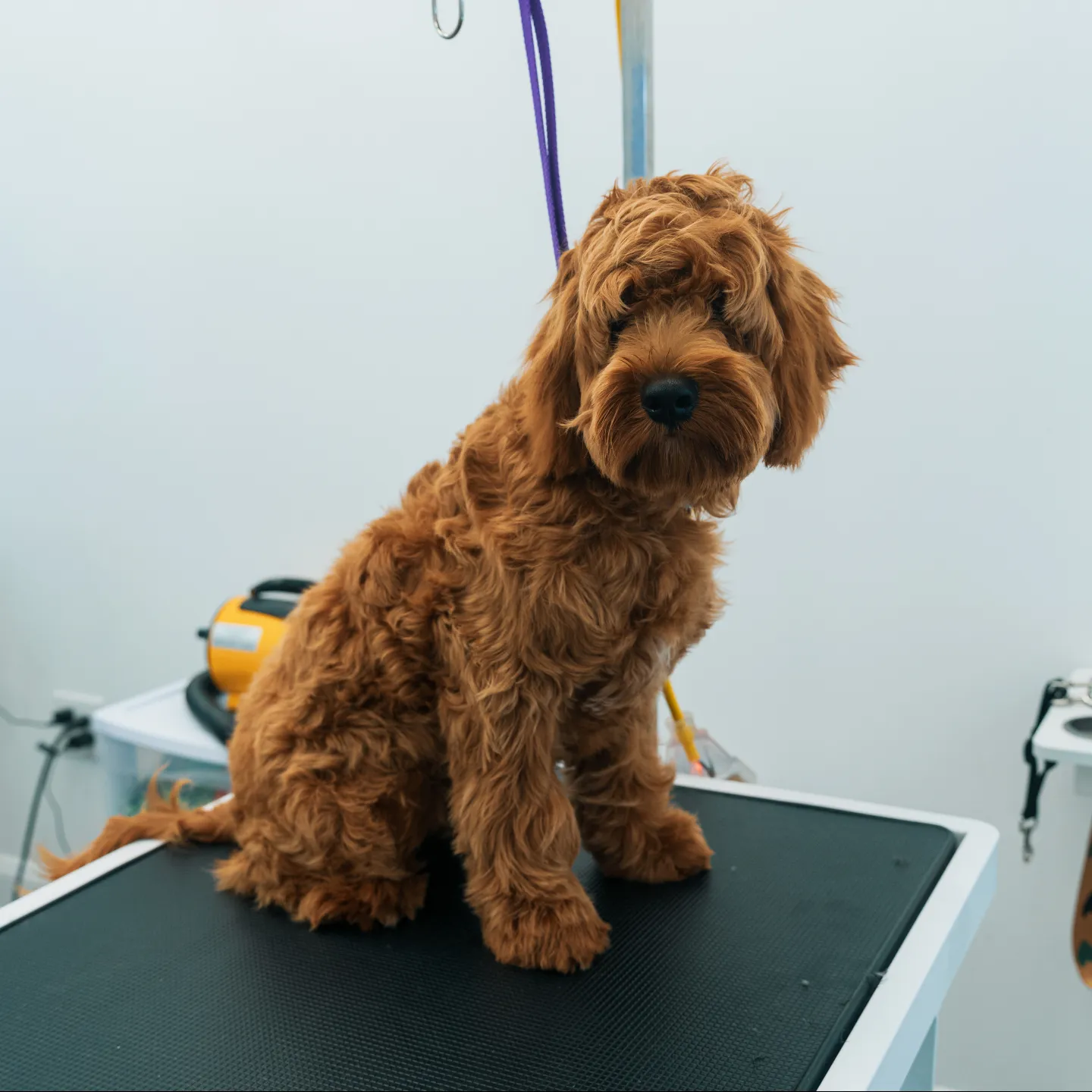
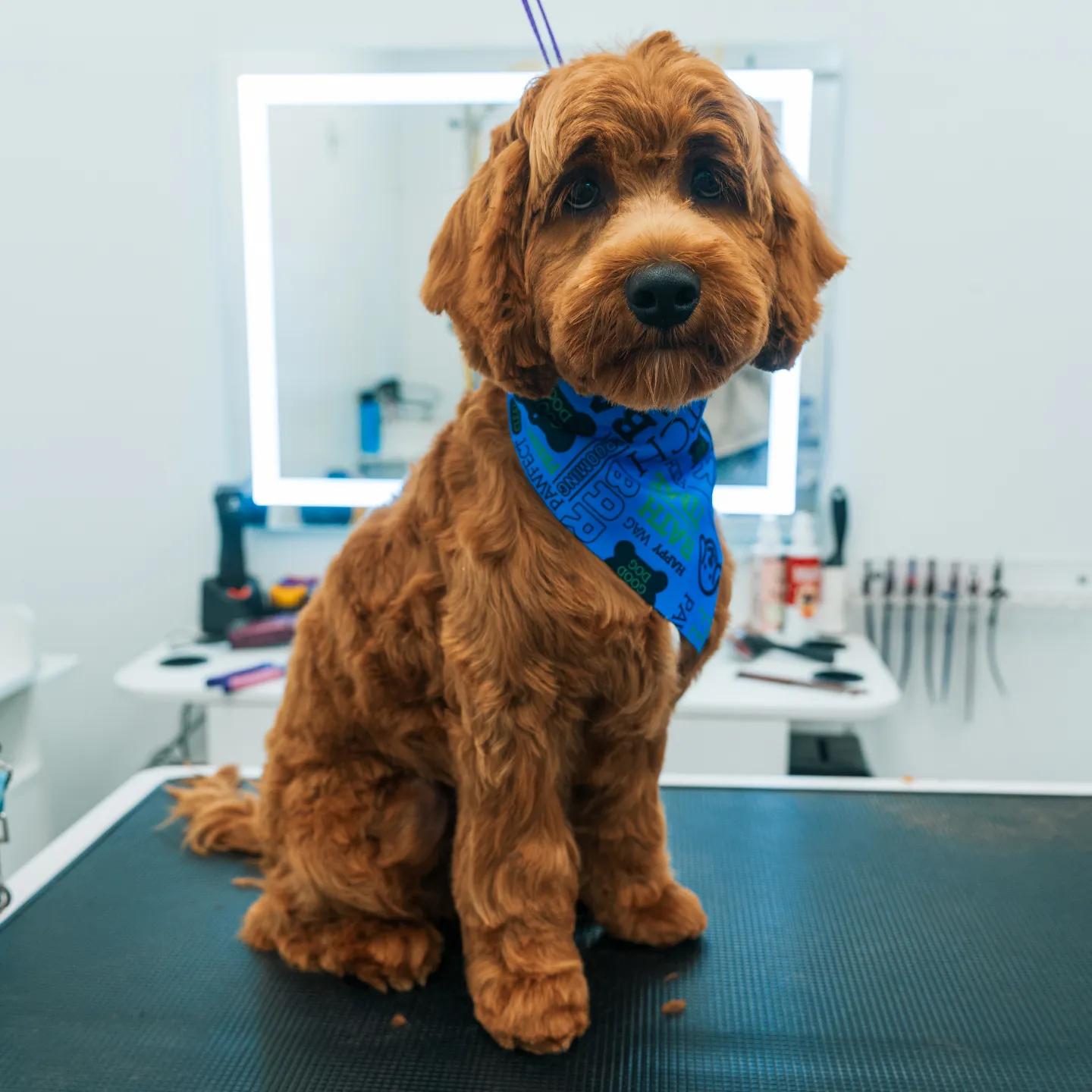
This is also why a matted dog sometimes goes home much shorter than the owner pictured. Working a clipper blade between felted hair and skin that we cannot see is the single riskiest thing in the trade, especially over the warts and skin tags that older dogs collect. Short is not a style choice in that situation. It is the safe way through.
Coming in on an interval, so nothing sits unnoticed for a year
Here is the part that actually matters. A single finding tells you very little. Two findings, spaced apart, tell you a great deal — because the question a vet most wants answered about a lump is whether it has changed.
A dog seen every six to eight weeks gets that comparison built in for free. A dog seen once a year does not: everything found is found for the first time, with no history behind it, and anything that appeared in month two has had ten months to itself.
The interval that suits your dog depends on the coat, not on us. Doodles, poodle crosses and anything curly need the shortest cycle. Double-coated dogs need a proper de-shed rather than a haircut. Smooth-coated dogs may genuinely need very little — and if that is your dog, a bath and brush is a perfectly good reason to come in, and a much cheaper one. Bath and brush runs $45 to $125 by weight; a full groom with a haircut runs $85 to $165.
And to be plain about it: if your dog is short-coated, comfortable, and you are happy to run your hands over him weekly yourself, you do not need us for skin checks. Do it on the sofa, be systematic, and you will find what we would find. The reason to book is the coat work. The head-to-tail check is what comes with it.
Questions people actually ask
The groomer found a lump. Should I panic?
No — but do call. Us mentioning it does not mean something is wrong; it means your vet, not us, is the one who decides what it is. What you have now is a location and a date, which is exactly what a vet needs to work with. Bring both to the appointment. A lump nobody knows about is the only genuinely bad version.
Can you tell me whether it's cancer?
No, and neither can anyone else without testing it. A groomer who tells you a lump is "just fatty" is guessing, and a guess that turns out wrong costs you months. We will tell you exactly where it is and how it felt. Everything past that belongs to your vet.
What happens if you find a tick during the bath?
We will tell you where it was, so you can point your vet at the exact spot. What we will not do is tell you whether it transmitted anything or how long it had been attached — that is a veterinary question, and Suffolk County infection rates make it one worth asking rather than assuming.
My dog is very matted. Am I going to get bad news?
Possibly, and it is better to know. Matting hides skin, so heavily matted dogs produce the most findings — usually irritation, old scabs or trapped debris. None of it was caused by the shave-down; the shave-down is what made it visible. We will tell you what we see and it goes to your vet like anything else.
Do I get the same check on a bath and brush as on a full groom?
Yes. The check is a by-product of the handling, not of the haircut. Brushing out, bathing to skin and drying every section happens either way, so a bath and brush covers the same ground.
How often should I come in for this to be useful?
Every six to eight weeks is where most coats sit, and it happens to be the interval where change becomes visible. If your dog's coat genuinely needs less, come less — the useful thing is regularity, not frequency.
Book the groom. The once-over comes with it.
Pick a time online, tell us anything your vet has already identified, and we will work around it. Anything new we find, you will hear about at pickup — in plain language, with a location.
See pricing & book ›16 Laurel Rd, East Northport, NY 11731 · Tue–Sat 9–5
Ready to Pamper Your Pet?
Book a grooming appointment today and give your furry friend the spa treatment they deserve.
Book an Appointment