
Puppy Cut vs Teddy Bear Cut vs Breed Trim: What to Ask For
Lillian Ruff Pet Spa
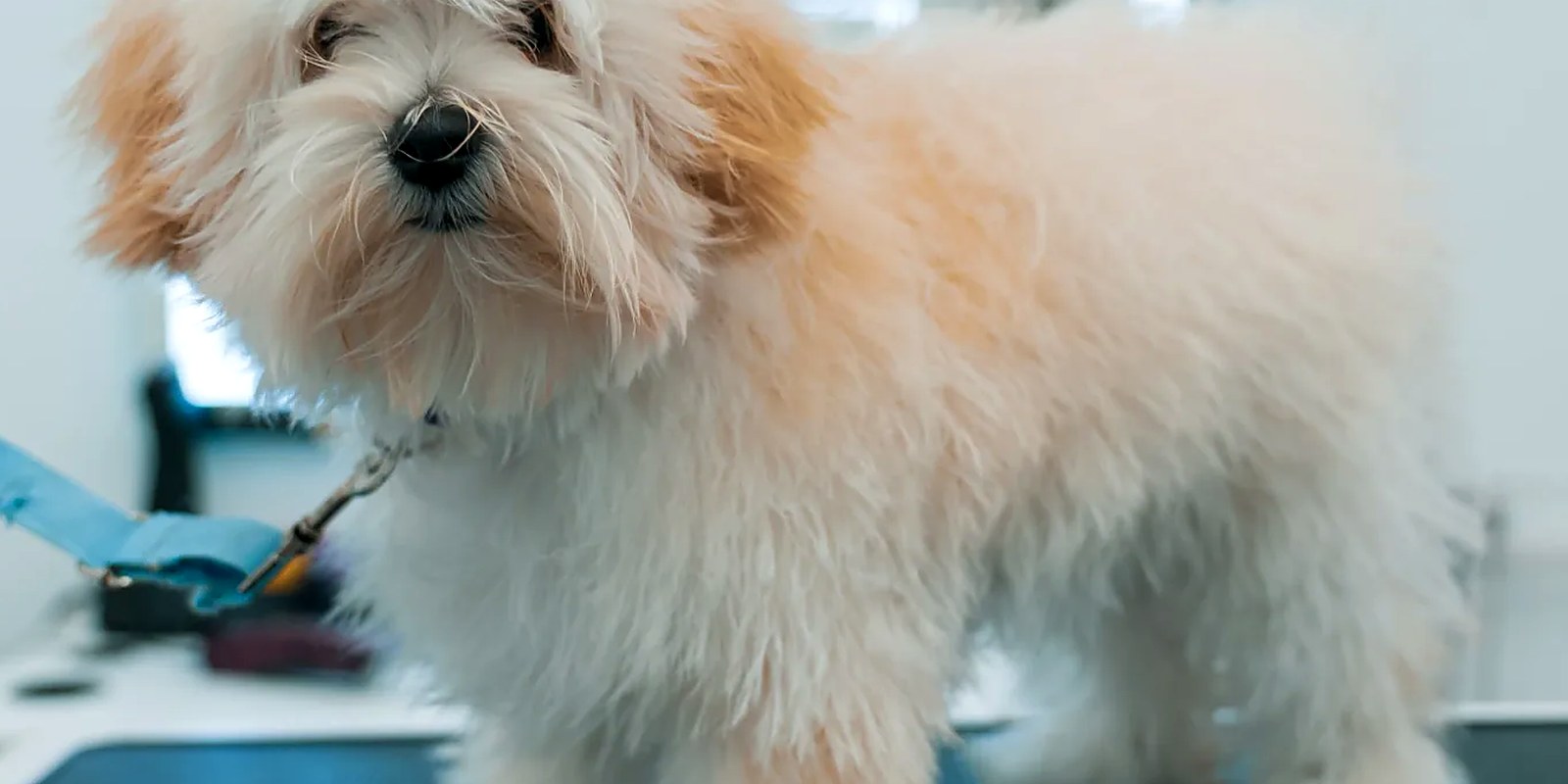
Three haircut names, one set of clippers, and a lot of confusion. Here is the honest version: two of these names mean almost the same thing on the body, and the real difference lives in the head. Once you know that, you can book a haircut without any fear of getting back a dog you do not recognize.
None of these three names is a regulated term. What actually decides how your dog looks is the length set on the body, and whether the face is left long and scissored round or taken short. Tell your groomer those two things and the name stops mattering.
Why these three names get used to mean the same thing
There is no governing body for pet haircut vocabulary. "Puppy cut" and "teddy bear cut" are shop words that drifted between salons for decades, and they drifted differently in different shops. One groomer's teddy bear is another groomer's puppy cut with a rounder face. Neither of them is wrong, because there was never a standard to be wrong about.
"Breed trim" is the exception. That one points at something real: the outline written into a breed standard — the schnauzer's furnishings and skirt, the westie's jacket, the cocker's skirt, the shih tzu's topknot. It is the only one of the three that has a reference picture behind it.
So when a request goes sideways, it is almost never because the groomer ignored you. It is because "short but not too short, teddy bear style" describes about nine different dogs.
Puppy cut: one length all over, and the dogs it suits
A puppy cut, in its plainest form, is one even length over the whole dog — body, legs, and head all set with the same comb or blade. It is called a puppy cut because it approximates the soft, uniform coat a young dog has before the adult coat comes in and the breed silhouette starts to appear.
Length is set with clipper comb attachments, and most requests land somewhere between a quarter inch and about an inch and a half. Shorter is faster to dry and easier to keep. Longer looks fluffier and mats sooner.
It suits:
- Dogs whose owners are honest that brushing happens twice a week, not twice a day.
- Coats that mat behind the ears, in the armpits, and where the harness sits.
- Puppies on their first or second full groom, where the goal is a calm experience more than a magazine outline.
- Senior dogs who cannot stand comfortably for a long scissoring session.
The trade-off is honest and worth knowing: if it really is one length everywhere, the head loses shape too. The muzzle goes as short as the back. Some dogs look wonderful like that. Some look like a different dog. If you want the body short but the face to keep its shape, what you actually want is the next one.
Teddy bear cut: what actually changes, mostly on the face
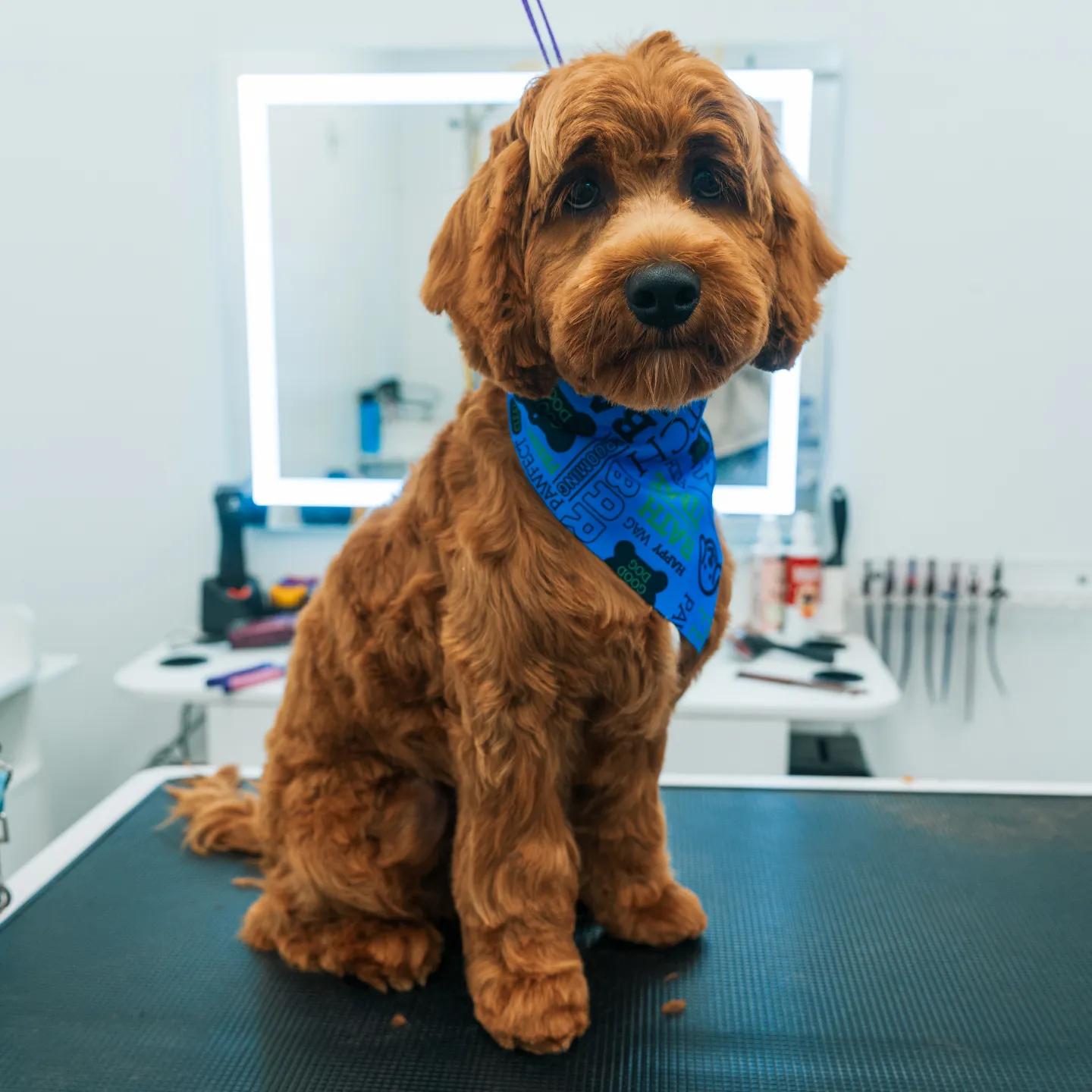
On the body, a teddy bear cut is frequently identical to a puppy cut. Same comb, same length. The work — and the extra time — is in the head.
Two practical things follow from that. First, it takes scissor work close to the eyes, which means the dog has to tolerate a hand near the face — some do, some genuinely do not, and a good groomer will tell you which yours is. Second, a long round muzzle collects water, food, and eye discharge. It needs a wipe and a comb at home most days or it goes crusty and then matted within a few weeks.
It also needs a coat that can hold the shape. A dog with a naturally smooth, short muzzle has nothing to scissor. No amount of asking will produce a teddy bear face on a coat that does not grow one.
Breed trim: when the standard outline is worth the extra scissoring
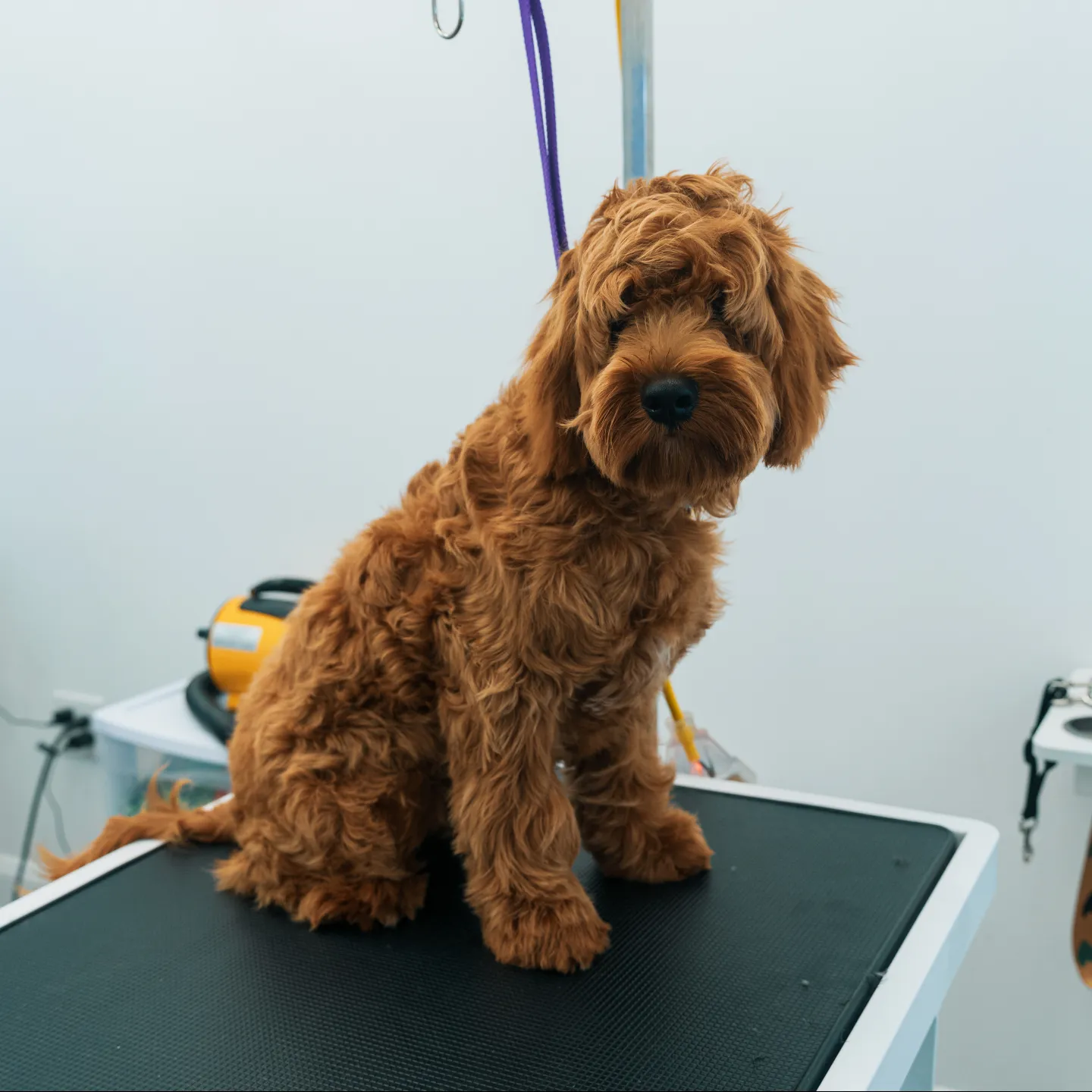
A breed trim follows the shape the breed is meant to have. It is not one length; it is several, deliberately different, blended together. A schnauzer keeps a short jacket with longer leg furnishings and a skirt. A cocker keeps a skirt and feathering. A poodle keeps whatever pattern you have agreed on.
It is more hand work, and it asks more of you between appointments, because the parts that make it look like a breed trim — the furnishings, the skirt, the feathering — are exactly the parts that mat. If those get neglected, the next groom removes them and you are back to one short length anyway.
Worth it when you brush regularly, you come in on a predictable schedule, and you actually like the silhouette. Not worth it if you want the look but not the maintenance. There is no shame in that, and a pet-length version of the same outline will make you happier all year.
To be straight about our limits: we do pet trims, including pet versions of breed outlines. We do not do show grooming, we do not do creative coloring, and we do not groom cats.
How to describe what you want without using any of these names
Skip the vocabulary entirely. Answer five questions instead, and any competent groomer anywhere will get you the right dog back.
Body length, in something measurable
Say a number in inches, or hold up your fingers, or point at a spot on the coat. "About half an inch" beats "short-ish" every time.
Legs: same as the body, or fuller?
Fuller legs read softer and rounder. Same-as-body reads neat and lasts longer.
Face: round and long, or short and tidy?
This single answer is the whole puppy-versus-teddy question. Nothing else about it matters.
Ears and tail
Long, shortened, or blended in. People forget these two and then notice them first in the photos.
How often you will really brush
Not how often you intend to. How often you will. Say the true number and you will get a haircut that survives until the next visit.
Two more things help more than any name. Bring a photo of a dog with the same coat type as yours, not just the same look you admire. And if a previous haircut went wrong, say exactly what bothered you about it — too short at the shoulders, ears cut off, face flat. That is far more useful than a style name.
Describe the dog you want to see walking back out. The name for it is our job, not yours.
If the coat is matted tightly to the skin, the clipper has to pass underneath the mat, and the result comes back short no matter which style you asked for. That is physics, not a choice. Trying to comb out a solid mat pulls harder on the skin than removing it does. If we find irritation, a hot spot, or anything under there that looks wrong, we will show you and tell you to see your vet — we do not diagnose or treat.
Pick one: a short table by coat type and by how much brushing you will really do
| Coat type | If you brush most days | If you brush now and then |
|---|---|---|
| Curly — doodle crosses, poodles | Longer body with a scissored round face; the teddy outline holds | One even length, half an inch or under, and book before it tightens |
| Silky — shih tzu, maltese, yorkie | Keep the length, add a topknot or a pet breed outline | One short length all over, face tidied round so it still has shape |
| Wiry — schnauzer, many terriers | Breed outline with the furnishings and skirt left on | Same body pattern, furnishings taken well back so they stay clean |
| Double coat — shepherds, huskies, goldens | Bath, thorough blow-out, tidy feet, rear and ears. No clipper on the body | Same, more often. A shave-down is still not the answer here |
| Smooth and short | Bath and brush; there is no haircut to have | Bath and brush, plus nails and ears |
Notice the bottom two rows. If your dog is smooth-coated or double-coated, you do not need a haircut at all, and asking for one of these three names would get you a conversation rather than a clipper. A bath and brush is the right booking, and it costs less.
Worth saying plainly: pricing is published by your dog's weight, not by the name of the haircut. Choosing a rounder face over a plain one is a conversation about time and coat, not a different price list. You can see the bands and book a slot yourself at lillianruffpetspa.com/grooming.
We are at 16 Laurel Rd, in the hamlet, Tuesday through Saturday. Two local notes that affect length choices around here. New York State's own deer tick surveillance splits the year into nymphs from May through September and adults from October through December, and in Suffolk County in 2025 roughly a quarter of nymphs tested positive for the Lyme bacterium — a shorter body coat makes your own tick check after the Deposit Road dog run or a walk through Northport Village Park much easier to do properly. In the other direction, the closest official weather station to us averages a daily low below freezing through December, January and February, so a bare shave-down in midwinter is rarely the kind thing to do to a small dog.
Go one short length when
- Brushing is realistically a weekly job
- The coat already has mats forming
- The dog dislikes handling near the face
- You want the longest possible gap between visits
Keep the scissored shape when
- You comb the face and legs most days
- You come in on a regular schedule
- The coat is long enough to hold an outline
- You care how the head looks in photographs
Questions people actually ask
Is a teddy bear cut just a puppy cut with a different name?
On the body, very often yes. The difference is the head: a teddy bear face is left long on the muzzle and scissored into a round shape, while a true puppy cut takes the face down to the same length as everything else. If you ask for one and mean the other, the head is where you will notice.
Will my dog come back shaved?
Not unless the coat's condition forces it, and if that looks likely we will tell you before we start rather than after. Bring the dog in before the coat tightens and you keep the choice.
Does the name of the haircut change the price?
No. Our pricing is published by weight — bath and brush from $45 to $125, full groom with haircut from $85 to $165 depending on size. The style is part of the conversation at drop-off, not a separate line.
Can you do a breed trim on a mixed breed?
Often, yes, if the coat behaves like the breed the outline comes from. A doodle with a dense curly coat can carry a poodle-style outline. A flat, sparse coat cannot hold the shape however carefully it is cut, and we would rather say so than send you home disappointed.
Should I go shorter for tick season?
Shorter coat makes your own tick checks easier and faster, which is the real benefit — the haircut itself is not a tick treatment. Prevention products are a conversation for your vet, not for us.
Do you groom cats, or do color work?
No to both. We do dogs only, and we do not do creative coloring or show ring grooming. If that is what you are after, we are not the right shop and we will say so on the phone.
Book the haircut, describe it at the desk.
Pick a time online, then tell us the body length and what you want the face to do. We will handle the vocabulary.
See pricing & book ›16 Laurel Rd, East Northport, NY 11731 · Tue–Sat 9–5
Ready to Pamper Your Pet?
Book a grooming appointment today and give your furry friend the spa treatment they deserve.
Book an Appointment