
Mud Season: Keeping a Dog Clean Through March on Long Island
Lillian Ruff Pet Spa
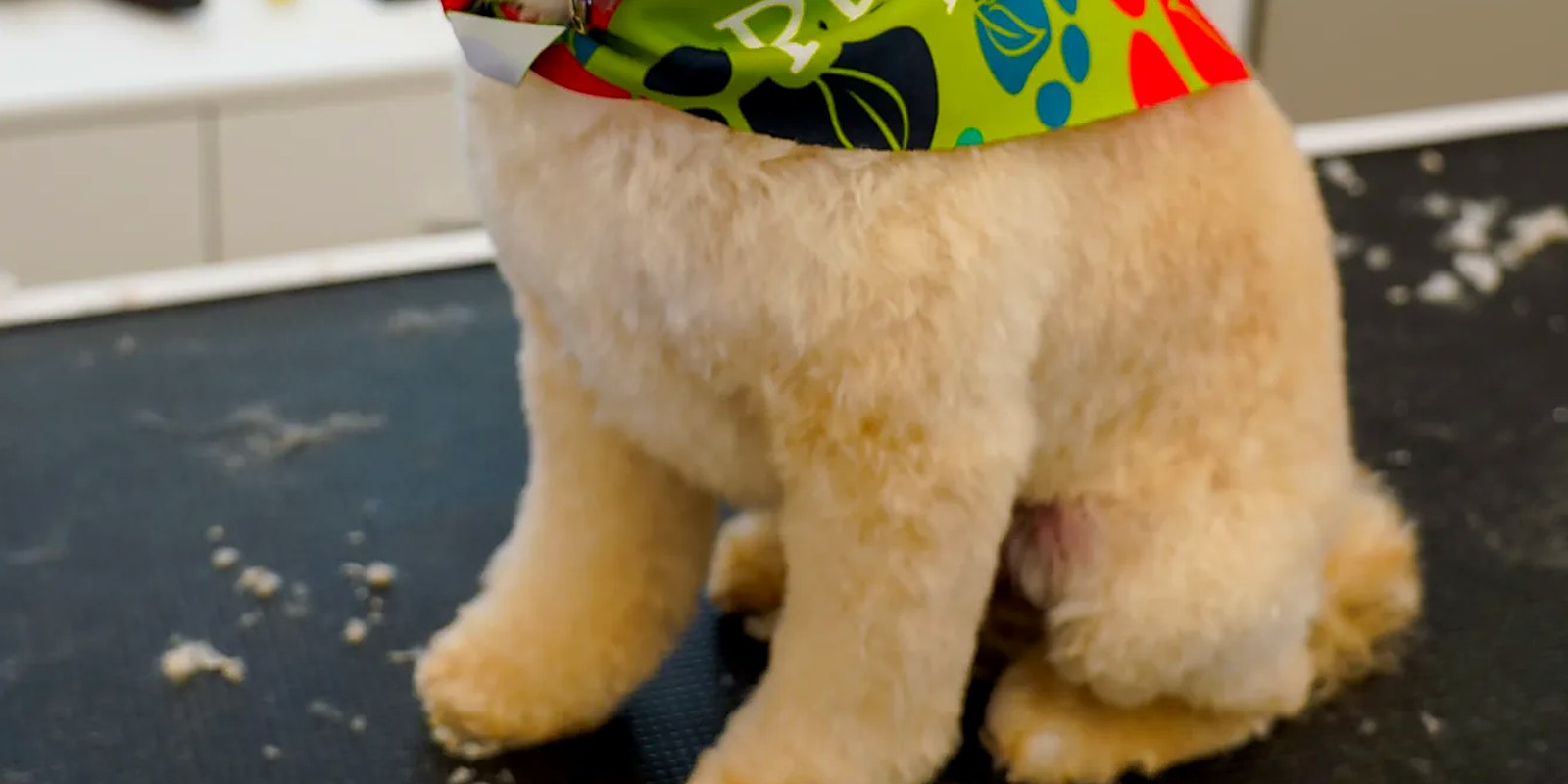
There is a specific March moment on Long Island where the ground stops being frozen and starts being soup, and your dog finds it within four minutes of leaving the house. The good news is that most muddy dogs do not need a bath. The bad news is that whether yours does depends almost entirely on what kind of coat it has — and getting that call wrong is how a fine coat turns into a matted one.
Short, smooth and harsh double coats: let the mud dry completely, then brush it out. Long, silky or curly coats: do not let it dry. Rinse the belly and legs with warm water at the door and dry the fur properly, because dried mud in a curl is grit, and grit is what starts a mat.
Why March is the worst of it here
At Long Island MacArthur Airport in Islip — the closest official weather station to East Northport — the mean daily low sits below freezing through December, January and February. That is why winter walks are relatively clean: the ground is hard. March still averages about six and a half inches of snow, and then it thaws. Frozen ground plus melt plus rain is the exact recipe for the stuff that ends up on your hallway floor.
It also means the mess is seasonal and short. You are managing a few weeks, not a permanent condition, so the goal is a routine you can actually repeat — not a full bath every single evening.
Where the mud actually ends up
Owners tend to look at the paws. Paws are the least of it. On a long-coated dog the real deposits are places you will not see unless you go looking.
Also worth checking: under the collar, under a harness where the straps cross the armpit, and at the base of the tail. Anywhere a strap holds damp hair flat against skin is a place mats form quietly.
Dry and brush, or rinse now?
This is the whole decision, and it comes down to coat structure. On a short, harsh coat, mud dries on the outside of the hair and flakes off. On a curly or wool coat, mud dries into the curl — every dried particle becomes a tiny anchor point, and the hair twists around it. Brushing that dry is like brushing sand out of wool. You will pull, the dog will hate the brush, and you will have taught it that grooming hurts.
| Coat type | At the door | Why |
|---|---|---|
| Short and smooth | Let it dry fully, then brush or towel it off | Mud sits on the surface of the hair and releases cleanly once dry |
| Harsh double coat | Dry, then work through with a slicker and an undercoat rake | The water-resistant topcoat keeps most mud off the undercoat |
| Wire coat | Dry and brush | Coarse hair does not trap fine particles the way soft hair does |
| Long and silky, with feathering | Rinse the legs, belly and feathering warm; do not let it dry dirty | Fine, soft hair binds around dried grit and tangles at the skin |
| Curly or wool (doodle-type, poodle, bichon) | Rinse warm, then dry properly to the skin | Dried mud in a curl is the fastest route to a solid mat |
Mud does not mat a coat. Mud that was allowed to dry in a coat, and then brushed, mats it.
The doorway routine
Keep this stuff by the door in March and the whole thing takes six or seven minutes.
Stop the dog on a towel
Two old towels: one to stand on, one to work with. Most of the floor damage happens in the first ten seconds while you are still finding something.
Feet first, one at a time
Warm water in a jug or a low bowl. Squeeze the water through the hair between the pads rather than wiping the top of the foot. Check the webbing with your fingers for packed grit.
Rinse the underside
Belly, groin, chest, the back of the legs. Plain warm water is fine for mud — you do not need shampoo unless something actually smells. Skip shampoo entirely if you are only rinsing one area.
Towel hard, then dry
This is the step people skip and the one that matters. Damp fur left to air-dry under a collar, in an armpit or in a thick leg fringe stays damp for hours. Towel firmly, then use a dryer on a cool or low-warm setting until the hair moves freely, or at minimum keep the dog somewhere warm and check the same spots an hour later.
Brush only when dry
Line-brush from the skin outward in small sections on the legs and belly. If the brush stops, do not force it — that is a tangle, and it wants fingers and patience, not a harder pull.
Skip the hot water and the human shampoo. If you find skin that is red, raw, weeping or smells off, or if the dog is limping or will not stop licking one foot, that is a vet visit rather than a grooming one — we can spot things and point them out, but we do not diagnose or treat them.
Where March mud comes from around here
The Town of Huntington's off-leash dog run is at the Animal Shelter on Deposit Road, right here in 11731 — roughly two-thirds of an acre, with waste stations, a shade and rain pavilion, and running water on site. It is open Monday to Friday 8am to 6pm and weekends 9am to 4pm, and it needs a free town permit for a licensed, rabies-current resident dog. If you would rather keep the walk on a hard surface during the thaw, the town's on-leash options include the upper paved path at Sunshine Acres Park in Commack and Frazer Drive Park in Greenlawn, and dogs are allowed on the paved areas and boardwalks at town beaches — but not on the sand itself, under Town Code. Leashes must be six feet or shorter.
Two small things that make the whole month easier. Keep a towel in the car, not just by the front door — a dog who dries off in a warm car for the ride home arrives with mud already set on the surface of the coat instead of worked into it. And on a long-coated dog, a harness that comes off at the door is kinder than one that stays on, because the straps are exactly where damp hair gets held flat and starts to felt.
One thing you can stop worrying about in March: New York State health surveillance splits deer-tick monitoring into two fixed windows, nymphs from May to September and adults from October to December. March sits outside both. What you are digging out of leg feathering right now is mostly grit and twigs — still worth a hands-on check of the skin, just not a tick panic.
When a professional bath is the sensible reset
Home rinses are for maintenance. There is a point where they stop being enough, and doing another one just spreads the problem around. Book the bath instead when:
A bath is the right call
- The coat has been rinsed and dried at home three or four times in two weeks and still feels gritty at the skin
- The legs or belly have gone slightly crunchy or clumpy rather than soft
- Your dryer situation means the dog is never quite drying all the way through
- You are between haircuts and the coat is fine, just filthy
Not yet
- One muddy walk on a short-coated dog — let it dry and brush it
- Muddy paws only, with a clean body
- A dog who was groomed last week and rolled in one puddle
A Bath & Brush is the service built for exactly this: a proper wash, a full dry down to the skin, and a brush-out while the coat is dry — which is the part almost nobody can replicate at home. It runs from $45 to $125 depending on your dog's weight, and the range is published on the site, so you can see roughly where your dog lands before you book anything. A full groom with a haircut is $85 to $165, also by weight, and in March plenty of dogs genuinely do not need one — the coat is fine, it is just dirty. We will tell you if that is the case.
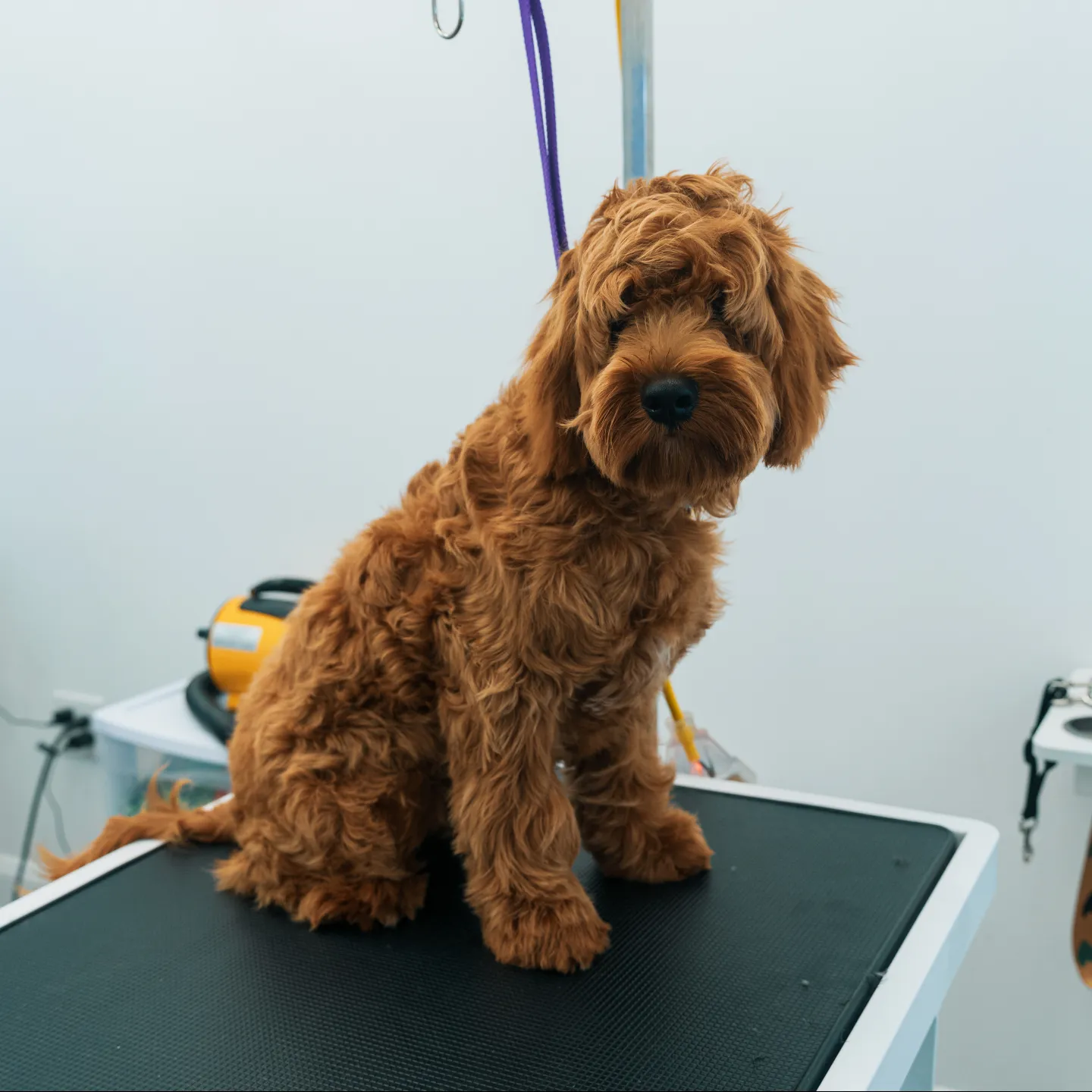
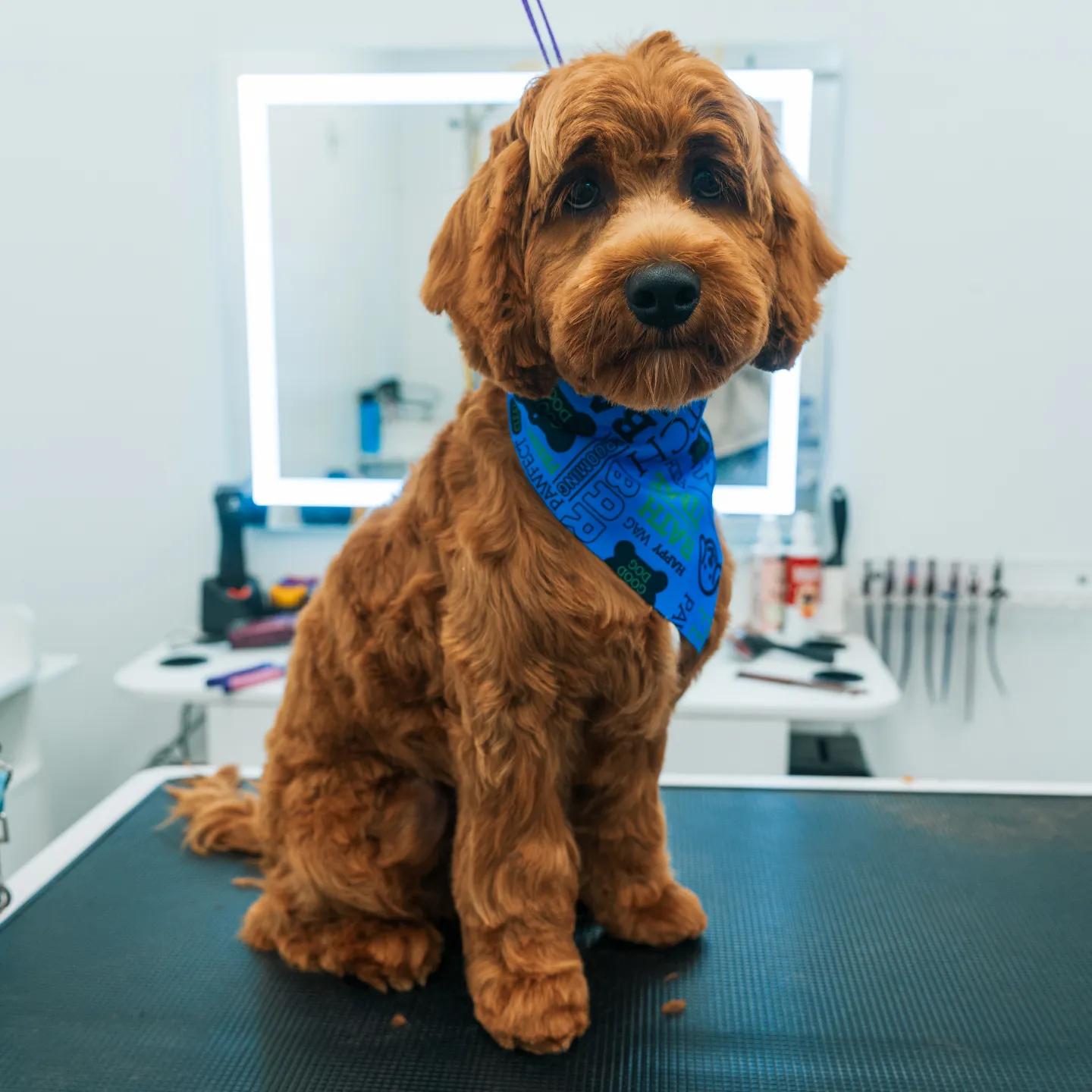
The honest caveat: if a coat has already matted tight to the skin over a muddy few weeks, brushing it out is not a kindness and sometimes is not possible. We will show you what we are finding and talk through the options before we do anything, including a shorter clip if that is the comfortable answer. That is a conversation, not a surprise you get at pickup.
Questions people actually ask
Do I need to bathe my dog every time he comes home muddy?
No, and on most coats you shouldn't. Frequent full baths on a short or double coat are unnecessary. Rinse the parts that are dirty, dry them properly, and leave the rest alone.
Can I use my own shampoo in a pinch?
Better to use plain warm water than human shampoo. For plain mud, water and a good dry does the job — shampoo is for grease and odor, not dirt.
My doodle's legs went matted after a wet week. What happens now?
Bring him in and we will assess it hands-on. Light tangles usually brush out after a bath and full dry. Mats that are tight to the skin often can't be brushed out comfortably, and we will talk you through a shorter clip before we start rather than after.
How much is a bath?
Bath & Brush runs $45 to $125 depending on your dog's weight. A full groom with a haircut is $85 to $165, same weight banding. Pricing is published on the site, which is not something most salons around here do.
Do you do daycare or boarding at East Northport?
No — East Northport is grooming only, Tuesday to Saturday. Our Ronkonkoma salon on Portion Road is open seven days and does offer daycare, boarding and retail, if that is what you need.
Can I just book online?
Yes. Pick your service and time on the grooming page. No phone tag, and you can see the pricing before you commit.
Book a mid-season bath and reset the coat.
Pick a Tuesday-to-Saturday slot online, see the price for your dog's weight before you book, and hand us the mud.
See pricing & book ›16 Laurel Rd, East Northport, NY 11731 · Tue–Sat 9–5
Ready to Pamper Your Pet?
Book a grooming appointment today and give your furry friend the spa treatment they deserve.
Book an Appointment