
Husky Grooming in East Northport: What a De-Shed Removes
Lillian Ruff Pet Spa
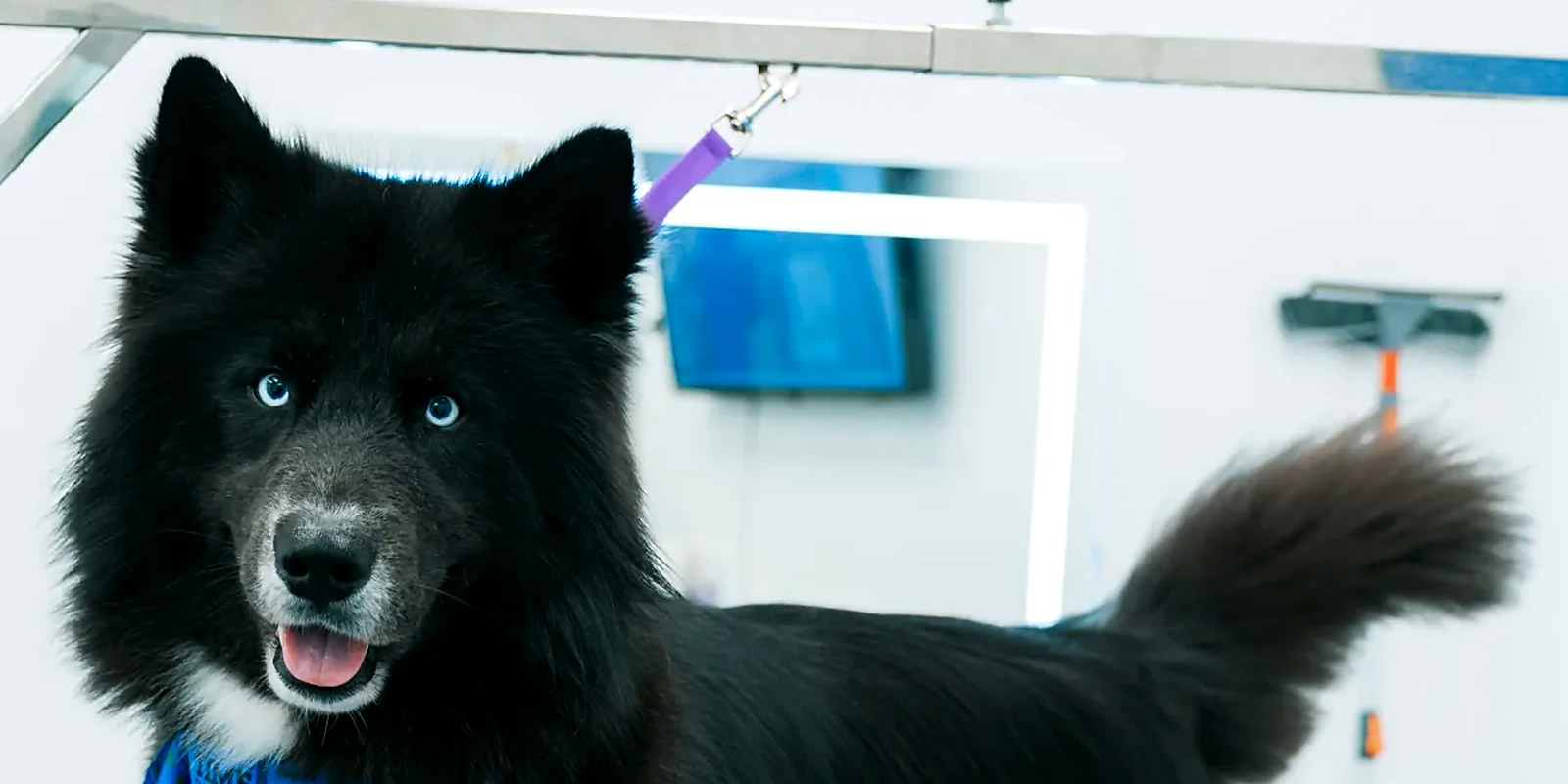
A Husky does not need a haircut. It needs the dead undercoat pulled out of it, and that is a different job — mostly water, shampoo, and a great deal of air.
If you have searched for a groomer because there is a second dog's worth of hair on your floor, this is the post for you. We groom Huskies and other double-coated dogs at our East Northport salon on Laurel Road, and the question we get more than any other is some version of should I just have him shaved down? The honest answer is almost always no, and the reason is worth understanding before you book anything.
Book a bath and brush, not a haircut. The coat comes out in the tub and under the dryer, not off with clippers. Expect a longer appointment than a small dog's bath — drying is the actual work.
What a Husky coat is built from
A Husky carries two separate coats that grow from the skin together and behave nothing alike. Most of the confusion about shaving comes from treating them as one thing.
When you run a comb through a Husky and it stops dead an inch above the skin, that resistance is usually packed dead undercoat, not matted guard hair. It has released from the follicle but has nowhere to go — the surrounding coat is holding it in place. That is the material a de-shed is designed to get out.
What a de-shedding bath and blow-out removes, step by step
Rough brush and skin check
A first pass with a rake and comb to lift what is already loose, and a look at the skin underneath — hot spots, scabs, thin patches, anything that changes how we work.
Shampoo worked down to the skin
This is the step most home baths miss. Water beads off a healthy Husky's guard coat. Shampoo has to be pushed through to the skin and left long enough to loosen the dead layer at the root.
Conditioner and a very thorough rinse
Conditioner helps dead hair slide free of the coat around it. Any product left behind will itch, so the rinse takes longer than the wash.
The blow-out
A high-velocity dryer forces air through the coat from the skin outward. This is where the volume comes out — dead undercoat is pushed out in sheets rather than pulled through the guard hair with a tool.
Final rake and comb-through
What the dryer loosened but did not eject gets combed out, section by section, with a second pass through the places a Husky packs first — behind the ears, the armpits, the britches and the base of the tail. The coat goes home full length, clean and lying flat.
What leaves the building is dead undercoat, loose dander, and whatever the coat has collected — dust, sand, road salt in winter. What stays on the dog is living coat and every bit of the guard layer. Nothing is cut.
If there is anything else you want looked at while the dog is with us, say so when you book rather than at drop-off. It is easier to build the time into the appointment than to add it once the dryer is already running.
Huskies mat in predictable places — behind the ears, in the armpits, in the britches at the back of the thighs, and at the base of the tail. If those areas have gone from dense to solid, forcing a rake through is painful and we will talk to you about it first. Separately, if you are seeing bald patches, symmetrical thinning, sores, or a dog who cannot stop scratching, that is a veterinary question, not a grooming one. We will point it out; we cannot diagnose it.
Why going very short rarely delivers what owners expect
The hope behind a shave-down is a cooler, cleaner dog and less hair in the house. In practice a double coat does not cooperate with any of the three.
What actually cuts hair in the house
- Getting the dead undercoat out on purpose, in a tub, with a dryer
- Regular brushing that reaches the skin, not the surface
- Keeping the coat clean so shed hair releases instead of packing
What clipping actually does
- Shortens the hair you find on the floor without reducing how much falls
- Takes the guard layer first — the part protecting skin from sun
- Collapses the air layer that insulates in both directions
- Can regrow uneven in texture and density, sometimes slowly
Shaving changes the length of what you vacuum up. It does not change how much there is.
There is a winter argument too. At the closest official weather station to us, Long Island MacArthur in Islip, the average daily low sits below freezing through December, January and February, and January averages a little over ten inches of snow across the 1991–2020 normals. A full coat is doing real work in those months. There are genuine reasons a vet or groomer will take a double coat short — surgical prep, a pelted coat that cannot be safely opened, a specific skin condition under veterinary direction — but "it is summer" is not one of them.
Where a Husky lands on price, and why drying drives the clock
Our pricing is published by weight, not by breed, and every price is on the site before you call.
| Service | What it is | Published range |
|---|---|---|
| Bath & brush | The de-shedding appointment: wash to the skin, condition, high-velocity dry, then rake and comb out. No clipping. | $45–$125 by weight |
| Full groom with haircut | Everything above plus a scissor or clipper cut. This is the service most Huskies do not need. | $85–$165 by weight |
Where a dog lands inside those ranges comes down to weight and nothing else — a Husky is priced the same as any other dog the same size, and there is no breed surcharge. Book it as a bath and brush rather than a full groom, and tell us it is a Husky when you book, so we schedule the right amount of time.
That time is the part owners underestimate. On a short-coated dog, drying is a few minutes at the end. On a Husky it is the main event, and it is what makes the appointment long rather than what makes it expensive. A coat that goes home damp at the skin is a coat that will itch and hold odor, so we do not rush it. Ask for the current time estimate when you book.
Worth knowing about the local market: published prices are uncommon among salons in this area, and so is real online booking. Of eighteen Long Island salons we audited from their own websites, seven offered online booking and three published any pricing at all. You can see both of ours and book at lillianruffpetspa.com/grooming without picking up the phone.
Brushing at home: what reaches undercoat and what only moves the top
Most owners are brushing faithfully and still finding hair everywhere, because the tool in their hand never touches the layer that is shedding.
The three highlighted above — the undercoat rake, the wide-tooth metal comb and a slicker worked in sections — get down through the guard hair to the layer that is actually shedding. The three that are not highlighted — bristle brush, rubber curry, grooming glove — feel productive and pull a satisfying amount of loose surface hair, but they are finishing tools. They smooth what is already on top and leave the packed layer where it is.
- Work in lines, not circles. Lift a section of coat with one hand, brush the exposed strip from the skin outward, drop it, move up an inch. Circling over the top of the coat just polishes it.
- Finish with the comb. If a wide-tooth metal comb travels from skin to tip anywhere you try it, you are done for that day. If it snags, the rake has more to do there.
- Go gently over bone. Hips, elbows and shoulders have very little padding, and a rake used hard leaves the skin sore and the dog unwilling next time.
- Stop when the dog is finished, not when you are. Ten patient minutes twice a week beats one long argument a month.
A de-shed at the salon and brushing at home are not substitutes. The blow-out clears the bulk that no home brush can reach; the brushing keeps the coat from packing back down between visits.
One reason to keep a Husky's undercoat open here rather than dense: ticks are easy to miss in it. New York State's own deer-tick surveillance is split into a nymph season running May through September and an adult season October through December, and in Suffolk County in 2025 roughly a quarter of nymphs collected carried the bacterium that causes Lyme, with the adults collected that fall testing positive at about twice that rate. If you use the Town of Huntington's off-leash dog run at 106 Deposit Road — the same hamlet and ZIP as our salon — or walk the on-leash trails at Frazer Drive Park in Greenlawn or the Jerome Ambro Memorial Wetlands Preserve in Northport, get your hands down to the skin afterward. A coat you can comb to the skin is a coat you can actually check.
Questions people actually ask
Will a de-shed stop my Husky shedding?
No. Huskies shed, and nothing a groomer does changes that. What a bath and blow-out does is remove a large volume of dead coat here rather than at your house, and leave the remaining coat open enough that new shed hair falls out instead of packing in. Owners typically notice the difference for weeks, not forever.
How often should we come in?
It depends on the individual dog, how much they blow, and how much brushing happens at home. Plenty of Husky owners settle into a rhythm of every couple of months, and tighten it up during a heavy turnover. If your dog combs to the skin easily and the house is manageable, you do not need to book — that is a real answer, not a modest one.
My Husky hates the dryer. Is that a problem?
Tell us when you book. High-velocity air is loud and some dogs never love it. We work at the pace the dog allows, keep air off the face, and if a dog genuinely cannot tolerate it we will say so rather than push. It is better to know before you arrive than to discover it in the tub.
Can I book just a nail trim?
The two services we publish online are a bath and brush and a full groom with haircut, both priced by weight, so there is no standalone nail booking on the page. If nails are genuinely all you need, call the salon and ask what we can do — we would rather answer that honestly on the phone than have you book and pay for a full service you did not want. It is also fine to ask about nails when you book a bath; just raise it up front so nothing is a surprise at pickup.
He has a section that has gone solid. Can you brush it out?
Sometimes, and sometimes not. A dense patch will usually open up with time and conditioner. A pelt — where the coat has fused into a mat against the skin — cannot be safely brushed out, and forcing it hurts. In that case the humane option is to remove that section short and grow it back, and we will show you exactly where and why before doing anything.
Do you groom cats, or take dogs for the day?
No cats. And the East Northport salon is grooming only — no daycare, no boarding, no shop. Our Ronkonkoma location, a short drive away at 835 Portion Rd, does offer daycare, boarding and retail seven days a week.
Book the bath, keep the coat.
Pick a time online, tell us it is a Husky, and we will schedule enough of it. Prices are on the page before you commit.
See pricing & book ›16 Laurel Rd, East Northport, NY 11731 · Tue–Sat 9–5
Ready to Pamper Your Pet?
Book a grooming appointment today and give your furry friend the spa treatment they deserve.
Book an Appointment