

Grooming a Three-Legged or Mobility-Limited Dog
Lillian Ruff Pet Spa
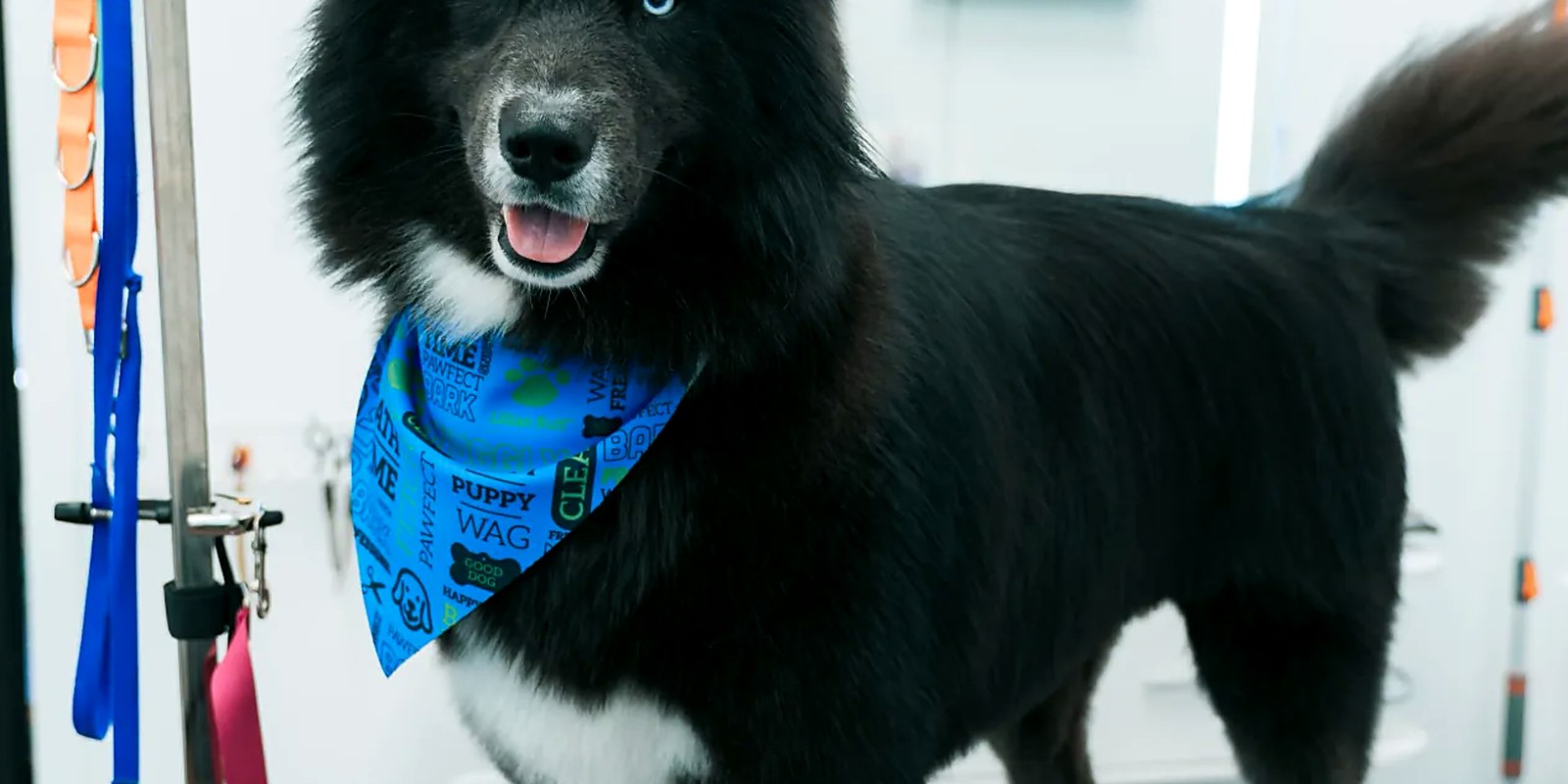
A three-legged dog is not a harder groom. It is a differently organized one. The coat still needs what the coat needs — the thing that changes is how long your dog can hold a position, and everything about the appointment gets built around that instead of around the clock.
The same is true for a dog with hip or spinal arthritis, a dog recovering from orthopedic surgery, a dog with a degenerative condition, or an old dog whose back end has simply gotten unreliable. The coat problem and the balance problem are separate problems, and the balance problem is the one that decides how the day goes.
Say it when you book. A note that your dog is three-legged, arthritic, or recently post-op changes how the appointment gets planned — the time set aside, the order of the work, and how much of it happens with the dog lying down instead of standing.
Balance, and why table time gets broken into shorter pieces
Here is the mechanical reality. When a groomer lifts a front leg on a four-legged dog to work under the armpit, the dog quietly shifts weight onto the other three and barely notices. A dog with three legs has nowhere to shift it to. Lift the remaining front leg on a front-limb amputee and you have not asked for a leg — you have asked the dog to balance on a tripod that just became a bipod, using a spine and a shoulder that are already doing extra work.
So the dog braces. Bracing is tiring, and a tired dog gets wobbly, and a wobbly dog on a table is where things go wrong. The fix is not clever equipment. It is arithmetic: do the work in short blocks, put the dog down or let them lie between blocks, and accept that the appointment takes longer in clock time even though the hands-on time is not much different.
The limiting factor is almost never the coat. It is how many minutes in a row the dog can hold a position without paying for it.
Practically, that means a groom might run as three or four working stretches with rests in between, and it means the ambitious version of the haircut is sometimes the wrong version. A slightly shorter, simpler trim that gets finished calmly beats a beautiful trim the dog had to endure.
Supporting a dog that can't stand for long
Most of what helps is unglamorous. Support goes under the chest and under the hips — the places a dog would rest weight anyway — rather than pulling on a limb to hold them up. A limb gets moved only as far as the dog offers it, and no further, because you cannot feel someone else's joint. If your dog has a range of motion that stops at a certain point, that point is the end of the conversation.
A great deal of grooming can be done with the dog lying on their side: one flank, belly, sanitary area, the inside of the legs, most of the brushing. Rolling to the other side is far easier on a dog than being asked to stand and pivot.
Works well
- Side-lying work, one flank at a time
- Support under the chest and hips
- Short blocks with real rests between them
- Bringing the harness or sling your dog already uses
- Booking the time of day your dog moves best
Ask us to change or skip
- Long unbroken stretches of standing
- Extending a limb to get a cleaner scissor line
- Any position your vet has told you to avoid
- A full haircut when a bath and tidy would do
- Finishing at all costs on a bad day
Bathing and drying without asking for a stance the dog can't hold
Footing is the whole game. A wet tub floor is difficult for a sound dog and genuinely frightening for one with three legs or a weak back end — one slip and you have taught the dog that baths are dangerous, which is a lesson that takes months to unteach. Non-slip matting under the feet matters more than any product on the shelf.
Water pressure matters too. A hand-held sprayer held close to the coat, at low pressure, does not push the dog. A strong jet does, and a dog who cannot counter a push has to lean into it.
Drying is where owners are most often surprised. High-velocity dryers move a lot of air, and air that moves a lot of coat also moves the dog. A mobility-limited dog often does better with more towel work, lower force, and longer drying time, or with the dryer used while the dog is lying down rather than braced upright. It is slower. It is also the difference between a dog who tolerates being dried and a dog who dreads it.
Ask how your dog will be dried, and whether they are ever left in a cage with a dryer running. You are entitled to a straight answer before you hand over the leash, and how a salon responds to that question tells you most of what you need to know.
Areas that need extra attention when weight is redistributed
When a dog loses a limb or stops loading one evenly, the rest of the body picks up the difference — and grooming is often where the evidence shows up first.
One boundary, stated plainly: a groomer notices things and points them out. A groomer does not diagnose. If we find a lump, a hot joint, a raw patch or a nail bed that looks angry, you will hear about it and the next call is to your vet, not to us.
What to tell us at booking, and what to ask your vet first
Book online and write it in the notes
Booking runs through our online system, and there is a place to add notes. Use it. Which limb, how long ago, and how long your dog can comfortably stand is more useful than any breed or coat detail.
Tell us what a bad moment looks like
Every dog with a mobility issue has a tell — a specific position they hate, a leg they will not let you touch, a point where patience runs out. Knowing it in advance means we work around it instead of finding it the hard way.
Ask your vet the medical questions
Whether your dog is cleared after surgery, whether any position or handling should be avoided, whether pain is being managed well enough for an hour of handling, and anything to do with sedation — those are veterinary questions with veterinary answers. We are not qualified to answer them and will not try.
Arrive already toileted, and unhurried
A walk and a chance to empty out before coming in removes one source of stress. So does picking a time of day when your dog is at their best rather than the slot that suits your calendar.
If you are keeping a mobility-limited dog moving locally, even footing is the thing to look for. Northport Village Park at the foot of Main Street — Cow Harbor Park — has paved paths, benches and restrooms and allows dogs on leash, which suits a dog that needs to stop often. Sunshine Acres Park in Commack has a paved upper path. Note that Town of Huntington code keeps dogs off town beaches except paved areas and boardwalks, and leashes must be six feet or shorter. The Town's off-leash run on Deposit Road here in East Northport is a fine facility, but off-leash play with strange dogs is not usually the right environment for a dog who cannot get out of the way.
Questions people actually ask
Do you charge more for a three-legged dog?
Pricing is published by weight — bath and brush runs $45 to $125 and a full groom with haircut runs $85 to $165, smallest dogs to largest. If you want the time and the plan confirmed before you commit, say so when you book and ask us to talk it through.
Will my dog need to be sedated?
Grooming salons do not sedate dogs. Sedation is a veterinary decision made in a veterinary setting, and if your dog genuinely cannot be handled comfortably without it, the honest answer is that the groom belongs at a vet's office rather than here.
My dog had surgery recently. How long should we wait?
Ask your vet, and take their date rather than ours. Wounds, staples, casts and healing joints are not something we can assess. Once you are cleared, tell us what the vet said about handling and positioning.
What if my dog can't get through the whole groom?
Then we stop. It is better to finish the essentials — nails, pads, sanitary, a clean coat — and leave the styling for another visit than to push a dog past what their body will do. Tell us at drop-off what your priority is if we only get to do one thing.
Would a mobile groomer be better for us?
Sometimes, honestly, yes. If getting your dog in and out of a car is the hardest part of the whole day, a service that comes to you removes the worst of it, and there are mobile groomers working this area. If the hard part is instead the handling itself — the positioning, the tub, the drying, the number of rests it takes — then a salon setup is usually the better fit, and the thing to do is ask us how we would plan the appointment before you decide. That is a real trade-off and it is worth thinking about before you book anything.
You're closed Sunday and Monday. Any other option?
Our East Northport salon runs Tuesday to Saturday, 9 to 5. Our Ronkonkoma salon is open seven days if a weekend day is the only one that works for you and your dog travels well.
If this describes your dog, the plan matters more than the haircut. What your dog's body can do on the day sets the shape of the appointment — how long the blocks are, how much happens lying down, where we stop. The styling is the part that bends. So tell us what that looks like before you arrive: which limb, how long they can stand, what they will not tolerate, and what you would most want done if we only get one thing done. We will build the visit around it. More about the East Northport salon is here.
Tell us about your dog before the first appointment.
Book online and add the details in the notes — which limb, how long they can stand, what to avoid. We plan the visit around that.
See pricing & book ›16 Laurel Rd, East Northport, NY 11731 · Tue–Sat 9–5
Ready to Pamper Your Pet?
Book a grooming appointment today and give your furry friend the spa treatment they deserve.
Book an Appointment