
Your Dog Swam in Lake Ronkonkoma. Now Dry That Coat.
Lillian Ruff Pet Spa
A dog comes out of the water, shakes twice, and within an hour the outside of the coat feels dry. That is the part that fools everyone. On a thick-coated dog, the water you actually need to worry about is still sitting against the skin, and it will still be there tomorrow.
This is one of the most common things we see all summer: a dog that looks fine, smells faintly of pond, and has a layer of packed damp fur underneath that the owner has no idea is there. It is not a disaster. It is just a job that a towel cannot finish.
Getting a coat dry to the skin within a few hours is what matters. On a short single-coated dog, a towel and some shade does it. On a double coat, a doodle or anything long, it usually does not — and that is where the smell, the mats and the itchy skin come from.
Why a thick coat holds water long after it looks dry
A double coat is two different things doing two different jobs. The outer guard hairs are coarse and shed water — that is the part that dries first and feels reassuringly dry under your hand. Underneath sits the undercoat: soft, dense, and packed close to the skin. It behaves less like hair and more like a sponge.
Air does not move through that layer on its own. A dog can lie in the sun all afternoon, feel bone dry on top, and still have a cold wet mat of undercoat along the spine, under the arms and around the base of the tail. Push your fingers in against the skin on the chest or the back of a thigh and you will feel it. That is the honest test — not the surface.
Lake and pond water also brings company. Silt, plant matter and general grit go into the coat with the water and stay there once the water dries out of the top layer. That is what you are actually smelling two days later. It is not the dog.
What staying damp does over 48 hours
Two things happen, and they happen in a predictable order.
First, the coat mats. Wet fur dries in whatever shape it was left in. Undercoat that dries compressed against the skin binds into a felted layer, and on curly or wavy coats every loose knot tightens as it dries. A dog that was easy to brush on Friday can be genuinely difficult by Sunday, and nothing happened in between except drying wrong.
Second, the skin gets unhappy. Damp against skin, under a coat that traps warmth, with no airflow — that is an environment. You will often notice odor before you notice anything else, then scratching, then a hot patch the dog will not leave alone. Ears are their own version of this: water goes in easily and a heavy, hairy ear does not vent.
Redness, a hot or weepy patch, head-shaking, a bad smell from one ear, or anything the dog keeps returning to — that is a vet visit, not a grooming appointment. Groomers see these things early because we are hands-on all over the dog, and we will tell you when we find one. We do not diagnose or treat them.
Wet fur dries in whatever shape you leave it in. That is the entire reason a blow-out exists.
Towel, and then what
Towelling is worth doing and it is not enough on its own. A towel lifts the surface water and some of what is just below it. It does not move air through a packed undercoat, and on a curly coat, rubbing with a towel actively makes knots.
Rinse first if you can
Plain water, at home, before the coat dries. It takes out most of the silt and plant matter, which is what causes the lingering smell.
Blot, do not scrub
Press and squeeze with the towel rather than rubbing back and forth. On wavy and curly coats, rubbing is how a knot becomes a mat.
Dry the ears and the pits
Wipe the outer ear dry with a cloth — nothing pushed down into the canal. Then check armpits, groin, the back of the thighs and the base of the tail. Those stay wet longest.
Brush while it is still damp, in layers
Lift the coat and work from the skin outward in sections. Brushing only the top of a wet coat leaves the mats where they are and hides them.
Check with your fingers, not your eyes
Skin-level, a few places on the body. If it is cool and damp down there hours later, air-drying is not going to finish the job.
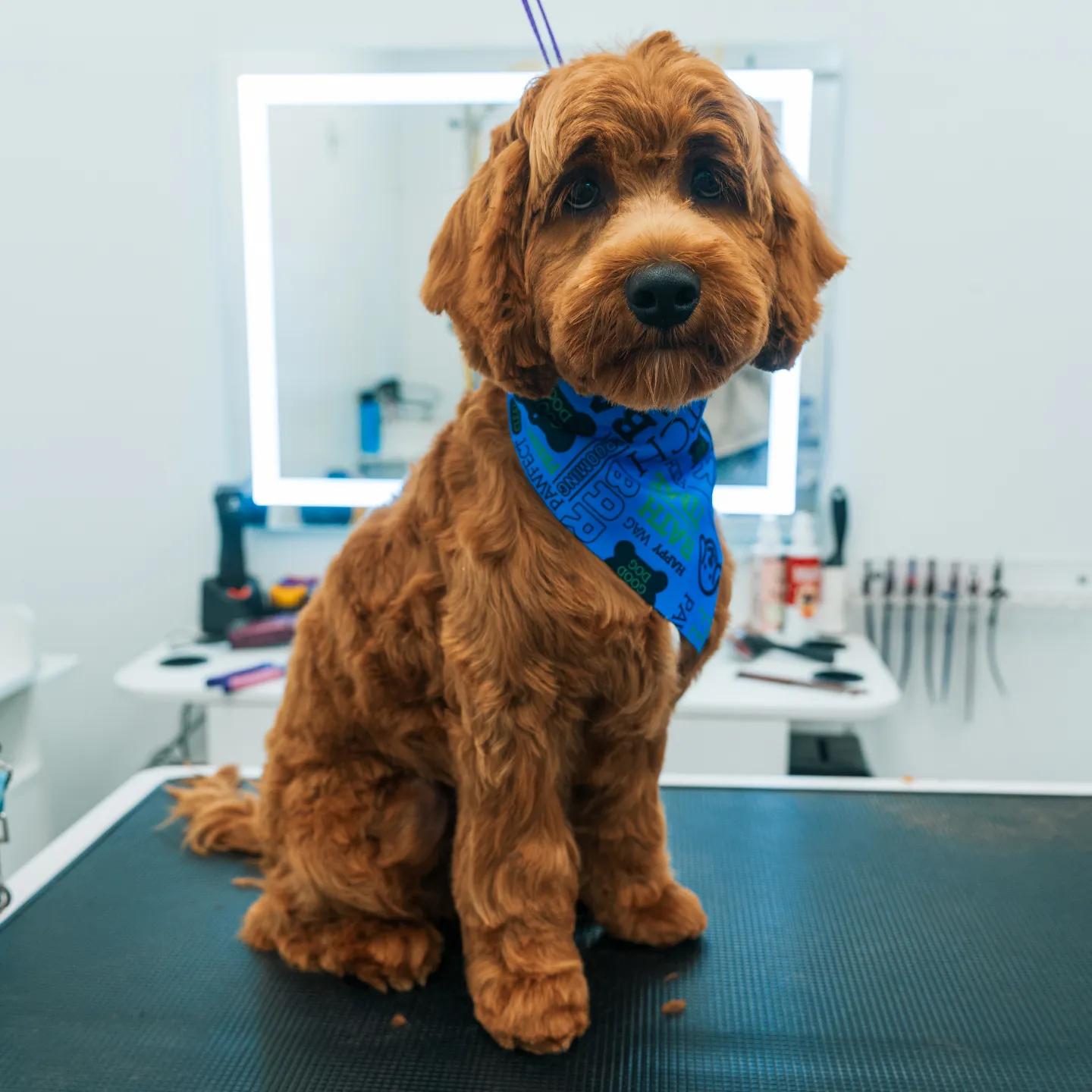
What a salon dry adds is force. A high-velocity dryer pushes air right through to the skin and blows water out of the undercoat rather than waiting for it to evaporate. It also lifts and separates the coat while it dries, so the fur sets open instead of setting flat and packed. That is the same tool and the same pass that makes a bath and brush worth booking after a swim — it is not an add-on, it is the point of the appointment.
The coats that suffer most
| Coat | What a towel gets | What is left underneath |
|---|---|---|
| Short single coat | Nearly all of it | Very little. Towel, shade, done. |
| Double coat | The guard hairs only | A soaked undercoat that can hold damp for a day or more. |
| Curly or wavy — doodles, poodles | The surface curl | Water held inside the curl, drying straight into tight knots. |
| Long silky | The outer length | Damp at the part line; mats behind the ears and in the armpits. |
| Wiry terrier | Most of the jacket | Damp furnishings on legs and beard. |
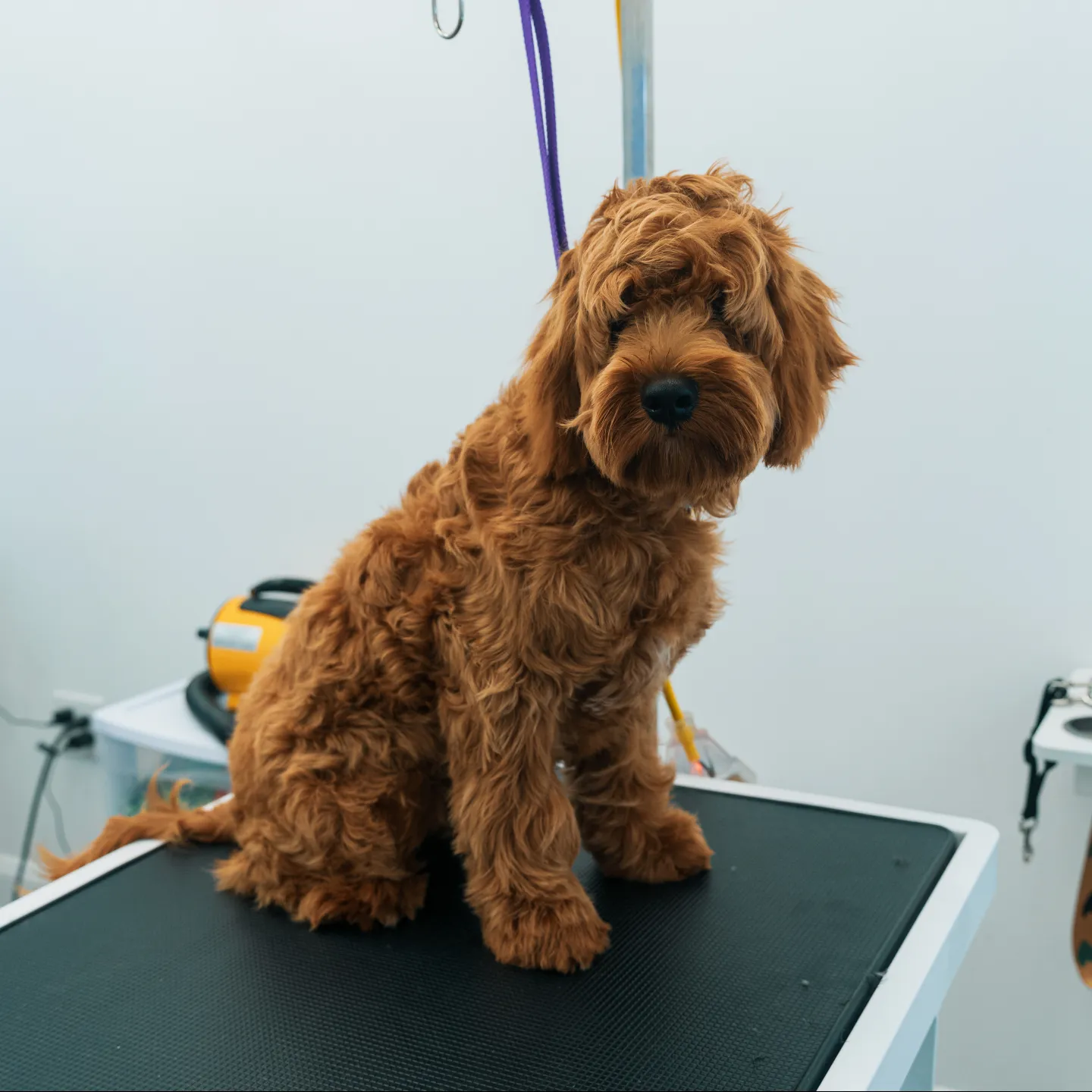
Doodles are the ones we end up shaving down after a summer of swimming, and it is almost never neglect — it is a dog that went in the water most weekends and was towelled each time. Each cycle tightens the coat a little more at the skin while the top still brushes out fine. By the time it feels different from the outside, it is felted underneath.
Double-coated dogs are the other group. A retriever or a shepherd will swim happily and then carry that water home in the undercoat, which is exactly where you least want it sitting.
When you do not need to book anything
Plenty of dogs do not need us after a swim, and we would rather say so.
Towel and go
- Short, flat, single coats
- Dogs that swim in clean water and get rinsed straight after
- A quick dip where the coat never soaked to the skin
- Dogs you brush through to the skin regularly anyway
Worth a bath and brush
- Any curly or wavy coat that went fully under
- Double coats that are still damp at the skin hours later
- Lake or pond swims where silt went into the coat
- A coat that has started to feel dense or crackly to brush
- Repeat swimmers — a regular reset beats one rescue groom
We are at 835 Portion Rd, open seven days a week, and a bath and brush is priced by your dog's weight — $45 to $125. If the coat has already gone past brushing out and needs a haircut to fix, that is a full groom, $85 to $165. We will tell you honestly which one your dog needs when we see the coat, not before.
Booking a bath and brush after a swim
Sooner is better, and that is not a sales line — it is just how coats behave. A dog brought in the same weekend gets a wash, a proper dry and a brush-out. The same dog two weeks and three swims later may be past that, and then the kind option is a shorter haircut rather than an hour of pulling on felted fur.
If your dog swims most weeks through the summer, a standing bath and brush is the cheapest version of this problem. It keeps the undercoat open, keeps the silt out, and means nobody is ever making a shave-down decision on your behalf.
Questions people actually ask
How long does a thick coat really take to dry on its own?
Longer than most people expect, and it depends on the dog. The reliable check is not time, it is touch: push your fingers down to the skin on the chest, under a front leg and at the base of the tail. If it is cool and damp there, the coat is not dry regardless of how it feels on top.
Can I use my own hair dryer at home?
A human dryer works on heat, and heat on a dog's skin is easy to get wrong. If you use one, keep it on the coolest setting, keep it moving, and never hold it in one spot. It will still take a long time on a dense coat, because it is not moving enough air to reach the skin.
My dog swims in a pool, not a lake. Same issue?
The matting side is identical — water is water, and a coat that dries packed will mat either way. You skip the silt and the plant matter, so there is usually less odor. A plain rinse afterward is still worth it.
Should I shave my dog down for the summer so this stops happening?
Not as a default, and especially not on a double coat, where the two layers do real work regulating the dog. The better answer is drying properly and brushing to the skin. If a coat is already matted, a shorter cut may be the humane option — but that is a decision made looking at the coat, not booked in advance.
My dog smells like pond three days later. Is that normal?
It is common, and it means material is still in the coat. A proper wash and a full dry usually clears it. If the smell is coming from one spot, one ear, or comes with redness or scratching, see your vet first.
Do you groom cats, or do color and hand-stripping?
No to all three. We are a dog grooming salon — bath and brush, and full grooms with a haircut.
Get the coat dry properly.
Pick a time online, tell us your dog's weight, and we will handle the wash, the full dry to the skin and the brush-out.
See pricing & book ›835 Portion Rd, Ronkonkoma, NY 11779 · Open 7 days, 9–5
Ready to Pamper Your Pet?
Book a grooming appointment today and give your furry friend the spa treatment they deserve.
Book an Appointment