

Dog Scared of the Dryer? What Happens at Bath Time
Lillian Ruff Pet Spa
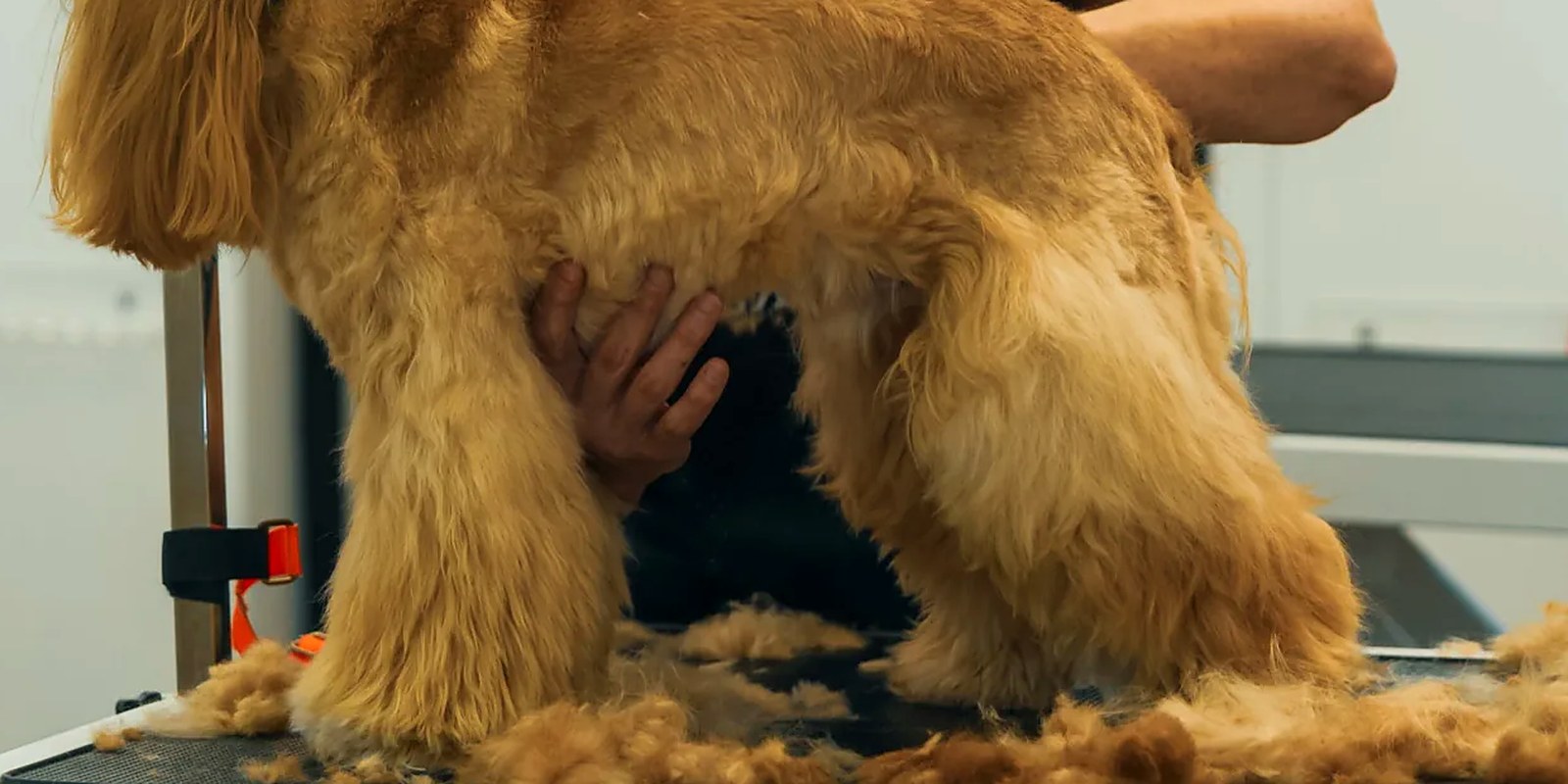
Owners tell us their dog hates being bathed. Often that is not quite what is happening. The dog tolerated the water fine. It was the dryer that lost them.
This matters because the two problems have completely different fixes. If a dog genuinely dreads water, the whole appointment is uphill. If a dog is only reacting to the dryer, that is one part of the visit rather than all of it, and there are several dials a groomer can turn before anyone gives up on it.
Tell us the words "sound-sensitive" or "hates the dryer" when you book, and say it again at drop-off. That one sentence changes how the appointment is set up before we put a hand on your dog.
Why the dryer, not the bath, is the step most dogs object to
A bath is warm, it is slow, and it mostly involves hands. Dogs read hands. The dryer is the opposite of all three. It is loud, it is sudden, it pushes air into the ears and against the face, and it moves the coat in a direction the dog did not ask for. From the dog's point of view, something invisible is pressing on them and roaring while it does it.
Add to that the fact that most dogs meet a high-velocity dryer for the first time as adults, at a strange address, standing on a raised table, already damp. That is a lot of new information at once. A dog who is fine with a hairdryer at home may still object here, because the equipment is a different animal entirely.
It is also the step with the least owner visibility. You saw the dog go in and you saw a clean dog come out. The part in between is the bit nobody describes, which is why we are describing it.
Dogs that bite at the airflow versus dogs that freeze
These look like opposite problems. They are handled differently, and it helps enormously if you can tell us which one you have seen at home.
The barker and the biter
- Snaps at the nozzle or the airstream, not at the person
- Barks over the noise, tries to grab the hose
- Recovers fast once the air stops
- Often more frustrated than frightened
The freezer
- Goes rigid, tucks, presses into a corner of the table
- Stops taking treats, stops responding to their name
- May tremble or drool
- Looks compliant, which is the trap
The dog that argues with the dryer is usually easier. The noise stops, the dog shakes off, and the next section goes fine. The dog that shuts down is the one we slow down for, because a frozen dog is not coping, it is enduring, and pushing through it teaches them the salon is a place where nobody listens.
A quiet dog is not always a comfortable dog. That is the single most useful thing a groomer learns about drying.
What can actually be adjusted
Before anyone concludes a dog "can't be dried," there are four separate levers, and they are usually pulled in this order.
There is also the order of operations. Some dogs do better dried in sections between other work, rather than standing through a single continuous dry at the end. Some do better with the dryer started at low speed while they are still in the tub, so the sound arrives before the sensation does.
If your dog is elderly, has a heart or breathing condition, has known hearing loss, or reacts to being handled in a way that seems painful rather than nervous, mention it to your vet before the next groom. We spot things and tell you what we noticed. We do not diagnose, and we will not push a dog through a dry that is not right for them.
Why skipping the drying is not free
The obvious solution is to towel the dog and send them home damp. It is tempting and it is occasionally the right call, but it should be a decision, not an accident, because a coat left to dry on its own behaves differently.
- Curly and wavy coats dry into the mat, not out of it. Doodles, poodles, Bichons and their crosses knit tighter as they dry unbrushed. A dog sent home wet can be noticeably worse a couple of days later.
- Double coats hold water at the skin. The topcoat feels dry long before the undercoat is. That damp layer is what people are smelling when they say the dog "smells like a wet dog for days."
- Loose undercoat does not come out of a wet dog. Most of the shed hair a bath loosens is removed during the dry. Skip it and you skip the main benefit of the appointment.
- Winter matters here. Islip's official 1991–2020 normals put average daily lows below freezing in December, January and February. A damp dog going straight into a cold car is not a comfortable dog.
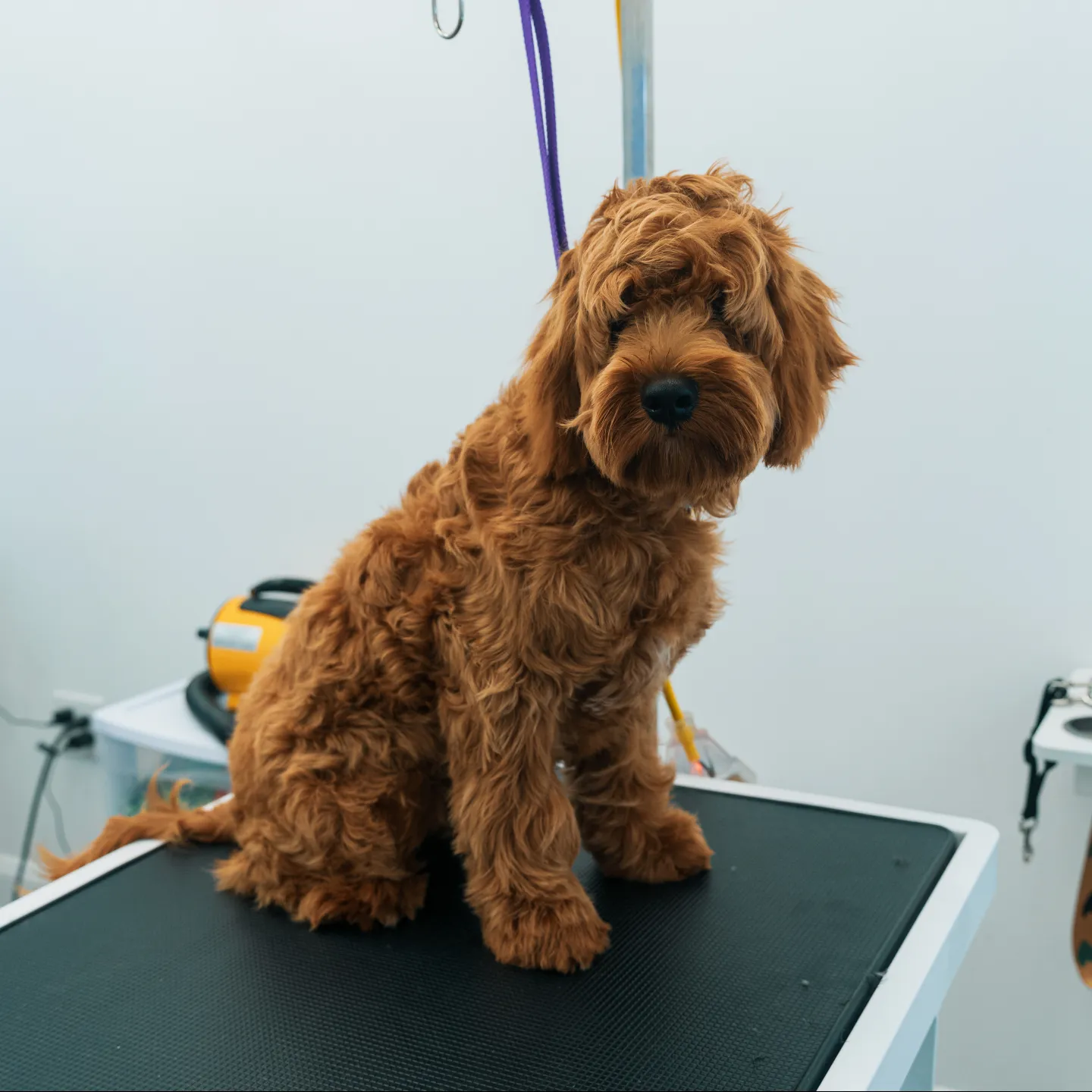
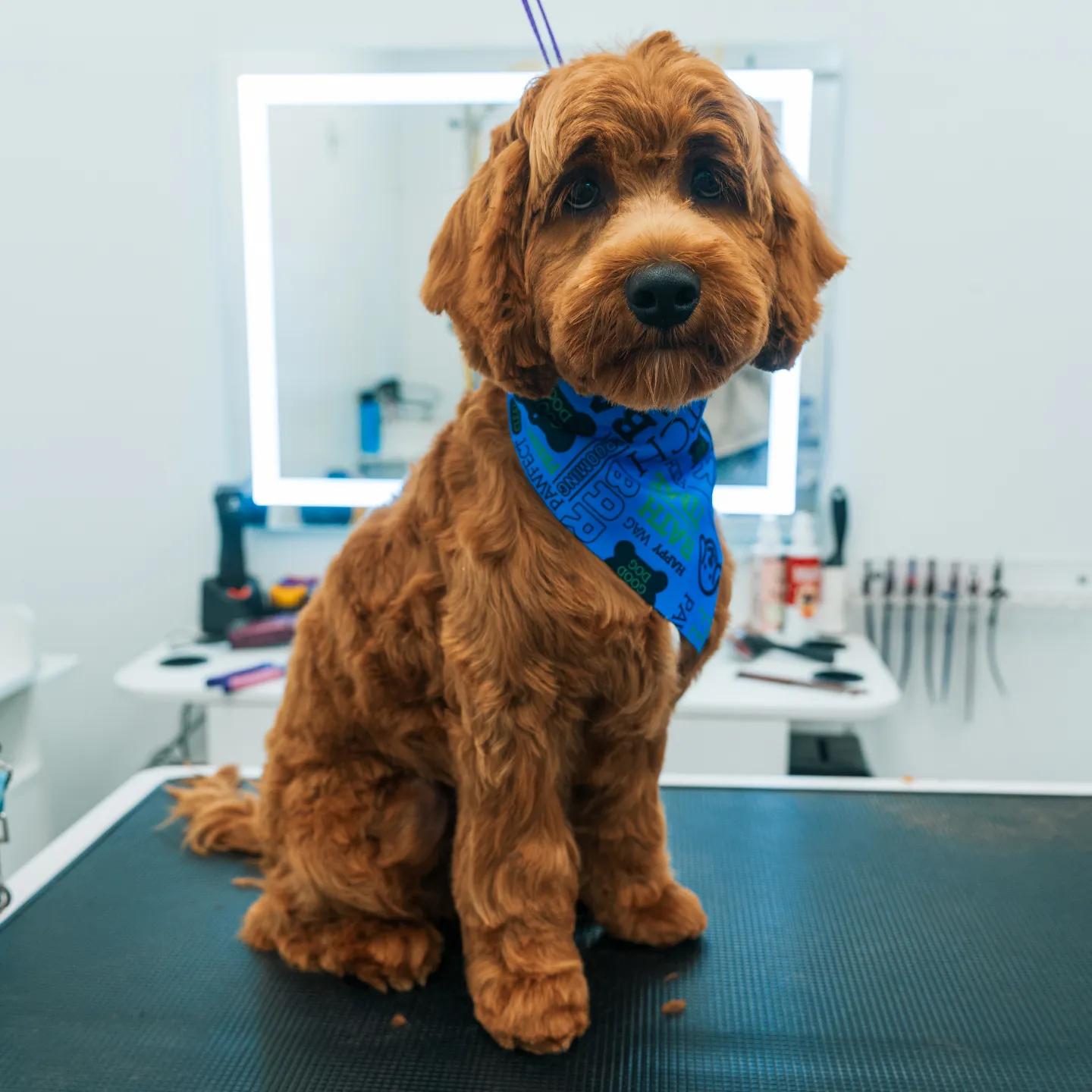
None of that means every dog needs the full high-velocity treatment. It means the trade is real, and you should know what you are trading. For a short-coated dog, a gentle dry and a longer towel is a small compromise. For a doodle, it is most of the groom.
Practicing the sound and the sensation at home
You can do genuine work on this between appointments, and it costs nothing. The goal is not to make your dog love the noise. It is to make the noise boring.
Sound only, at a distance
Run a hairdryer or vacuum in another room while your dog eats. No airflow, no handling. Just noise that predicts something good.
Same room, still no air
Move it closer over several sessions. If your dog stops eating, you moved too fast. Go back a step rather than pushing on.
Air on the body, never the face
Cool setting, low, aimed at the shoulder or flank from a foot away. A couple of seconds, then a treat, then stop while it is still going well.
Add the standing still part
Ask for a few seconds of standing on a non-slip surface, dry, no equipment. Standing still on a raised table is half of what we are asking for.
Short and frequent beats long and thorough. A couple of minutes a day across two weeks does more than one long determined session.
Tell us when you book, and tell us again at the door
We are at 16 Laurel Rd, Tuesday to Saturday, 9 to 5. Booking is online at lillianruffpetspa.com/grooming, where you can also see pricing before you commit. Of eighteen Long Island salons we audited from their own websites, only seven take bookings online at all and only three publish any pricing, so it is worth using both.
Wherever the booking lets you leave a note, "scared of the dryer" is the thing to write. If there is nowhere obvious to put it, say it out loud at drop-off instead. Thirty seconds of handover is worth more than anything we could guess at, and it is far better to hear it before the bath than to discover it halfway through the dry.
What we do with that information: the dog gets handled with the assumption that the dry is the hard part, not the easy part. Air speed starts low. Face and ears are done by hand. We watch for the freeze rather than waiting for the bark. And if the answer on the day is a partial dry and an honest conversation at pickup, that is what you get, rather than a dog who was pushed through it and hates the next visit more.
One more thing worth saying plainly: if your dog is short-coated, comfortable in the bath, and the only real issue is the dryer, you may not need a full groom at all. A bath and brush is the shorter appointment and the smaller ask. Start there, see how the dry goes, and build from it.
Questions people actually ask
Can you just skip the dryer completely?
Sometimes, and we will tell you what it costs. On a smooth-coated dog it is a minor compromise. On a doodle, poodle or a heavy double coat it undoes most of the point of the bath, because the loose undercoat and the brush-out both depend on the dog being dry. We would rather agree on a partial dry in advance than surprise you at pickup.
My dog is fine with the hairdryer at home. Why not here?
Different equipment, different volume, different room, and your dog is standing on a table instead of your bathroom floor. Home tolerance is a good sign and a real head start, but it does not always transfer on the first visit.
Will you sedate or use anything to calm my dog?
No. Anything of that kind is a conversation between you and your vet, and it has to be planned with them in advance, not decided at a grooming table. What we can do is adjust the handling, the speed and the pace.
Should I tire my dog out beforehand?
For a lot of dogs, yes, a walk first helps more than anything else you can do that morning. The Town of Huntington runs a permit dog run at 106 Deposit Rd here in East Northport, and Northport Village Park allows dogs on leash. A dog who has already emptied out is easier to stand still.
Is it better to book a shorter appointment first?
Often. A bath and brush asks less of a nervous dog than a full haircut and gets them a successful visit on the record. You can move up to a full groom once the drying stops being the problem.
What if my dog needs more than you can offer at East Northport?
East Northport is grooming only. If your dog would benefit from a longer, less compressed day, our Ronkonkoma salon on Portion Rd is open seven days and offers daycare and boarding alongside grooming. It is a short drive and it is a genuinely different setup.
Book it, and tell us about the dryer.
Pick a time online, say "sound-sensitive" when you book or at drop-off, and the visit gets planned around it.
See pricing & book ›16 Laurel Rd, East Northport, NY 11731 · Tue–Sat 9–5
Ready to Pamper Your Pet?
Book a grooming appointment today and give your furry friend the spa treatment they deserve.
Book an Appointment