

Sanitary Trim for Dogs: What It Covers and What It Fixes
Lillian Ruff Pet Spa

A sanitary trim is a short, close tidy of the hair around a dog's rear, genitals and inner thigh. It has nothing to do with the haircut you can see from across the room, and on a long-coated dog it is often the difference between a clean arrival home and a load of laundry.
Most owners have never heard it named. They know the symptom — the smear on the rug, the smell that shows up two days after a bath, the dog scooting across the kitchen floor — but they do not know there is a two-minute piece of grooming work that addresses a lot of it. So they never ask for it, and it never gets done.
Ask for a sanitary trim by name. It is the hair around the rear and belly clipped short so waste and urine cannot catch in it. It is not a haircut, and it will not fix a problem that is coming from the skin underneath.
What a sanitary trim covers, and what it does not
The area is small and specific. A groomer works with a short clipper blade, no scissors near anything delicate, and takes the hair down close but not bare. On most dogs it takes a couple of minutes and the dog barely registers it.
What it covers
- The hair immediately around the anus
- The genital area, front and back
- The inner thigh where the leg meets the body
- On long-coated dogs, the fringe on the underside of the tail that hangs into the same zone
- Sometimes a strip along the lower belly, if a male dog is soaking his own coat
What it does not cover
- The paw pads, the face, or anything else people sometimes lump in with it
- A shaved belly for cooling — that is a different request and a different conversation
- Anything inside the dog
- Any medical treatment of the skin, glands or digestion
- A full haircut. A dog can have a sanitary trim and still look exactly the same in photographs
That last point is worth sitting with, because it is why so many owners of short-coated dogs assume it does not apply to them. A Beagle, a Lab, a Pit mix — none of them need a haircut, and plenty of them still benefit from a rear tidy, especially as they get older or heavier.
Long coats, low clearance, and why mess ends up in the fur
Two things decide whether a dog stays clean back there: how long the hair is, and how much room there is between the dog and the ground.
Add weather to that. Winters here put snow and slush under every dog for weeks at a stretch — the nearest official weather station to East Northport, at Islip, averages roughly ten inches of snow in January and nine in February over the 1991–2020 normals, with mean overnight lows below freezing December through February. Wet coat plus a long rear fringe is how a small problem becomes a daily one.
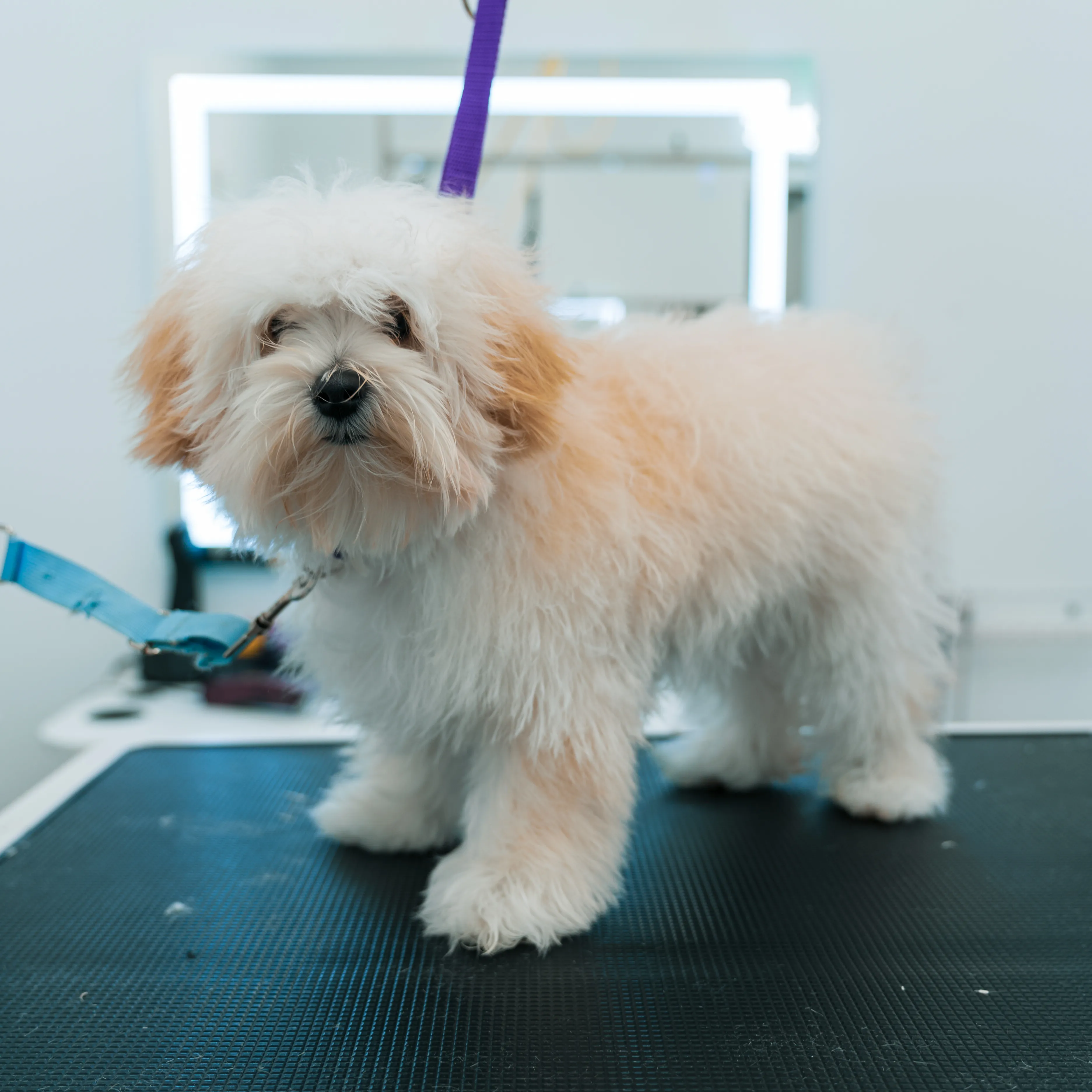
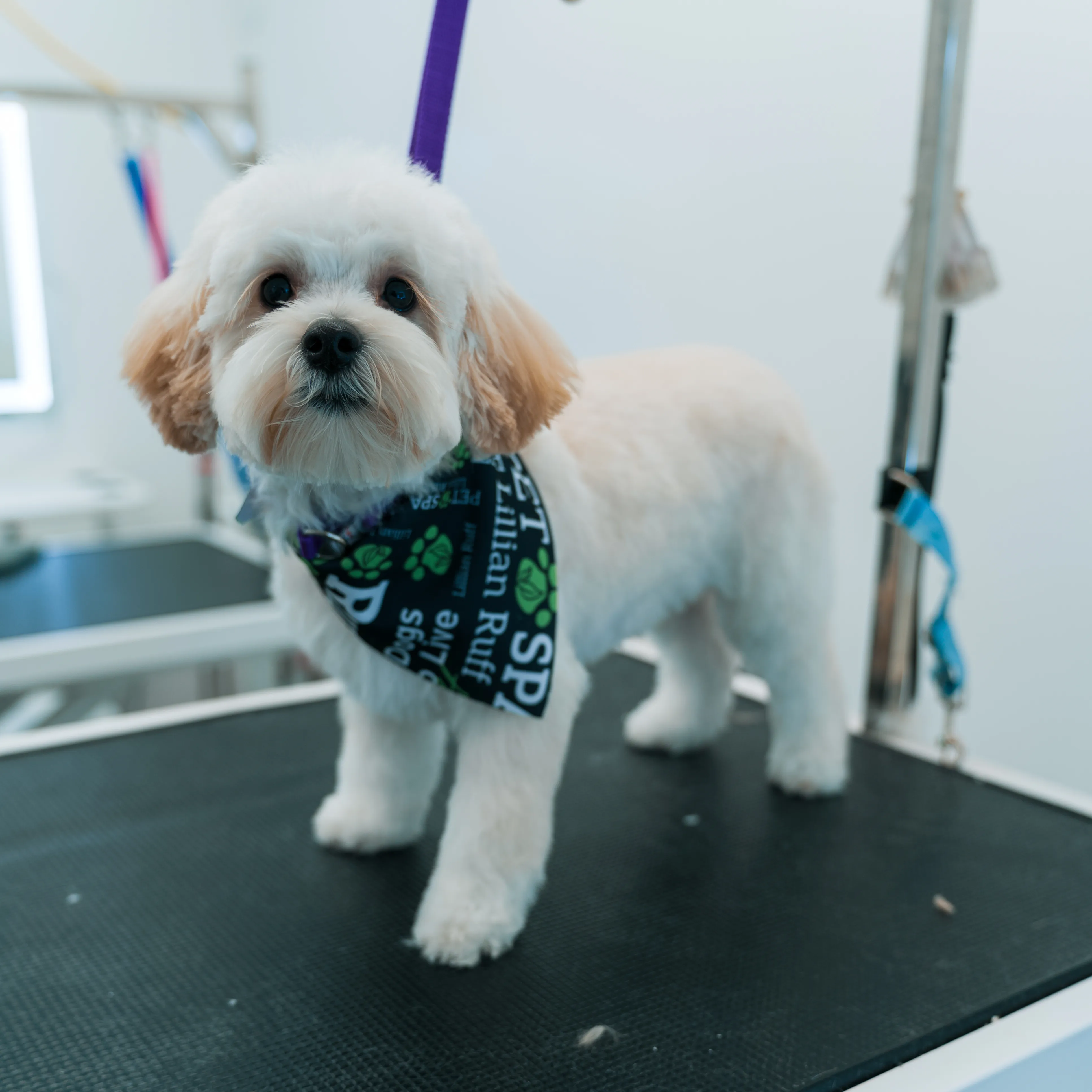
When fur traps waste against the skin, the skin is the real problem
Here is where a sanitary trim stops being a tidiness question. Hair that holds moisture and waste against skin, day after day, is not just unpleasant to be near. The skin under it stays damp, and damp skin under a mat is where things go wrong.
What a groomer sometimes finds when the hair comes off: skin that is pink or angry rather than pale, hair matted into a solid plate that has been pulling on the skin every time the dog moves, or a sore spot the coat was hiding entirely. In the worst version, the hair over the anus mats into a cap that partly blocks it — and by then the dog has usually been uncomfortable for a while without anyone knowing.
Skin in that area is thin and loose, and it lifts into scissors far more easily than people expect. A mat that looks like it is sitting on top of the coat is frequently attached to skin underneath, so the blades close on both at once. Let it be clipped, not cut.
A groomer is not a vet and cannot tell you what is causing angry skin. What a groomer can do is see it early, tell you plainly what they found, and say that it is worth a vet appointment. That is the whole job at that point — spot it and hand it over.
Straining, pain or a blocked rear is a vet call, not a grooming one
Some things look like grooming problems and are not. If your dog is straining to go, crying or flinching when the area is touched, licking or chewing at it constantly, or genuinely cannot pass anything — that is a veterinary appointment, and not one to sit on. Scooting has several possible causes, some of them medical, and sorting out which one is a vet's job rather than a groomer's.
A trim removes the hair. It does not treat the dog.
The honest version is this: if the mess is coming from hair length and coat texture, a sanitary trim solves it and keeps solving it. If it is coming from something inside the dog, the hair was never the cause, and clipping it will only make the underlying issue easier to see. Both outcomes are useful. Neither one is a diagnosis.
Keeping the area workable between full grooms
You do not need an appointment every time something goes wrong. Most of what keeps this area manageable happens at home, and it takes very little.
Look, weekly
Lift the tail and actually look. Ten seconds. You are checking for hair that has started to clump, redness, or anything stuck. Catching it at clump stage means it combs out. Catching it a month later means it gets clipped.
Comb, do not just brush
A slicker brush glides over the top of a forming mat and leaves it there. A metal comb finds it. Work the comb through the inner thigh and under the tail, gently, and stop if it snags rather than pulling.
Wipe, then dry
A plain damp cloth or an unscented pet wipe handles day-to-day. The part people skip is drying afterward — leaving the area wet is half the problem you were trying to fix.
Check after walks in long grass
Nymph-stage deer ticks are active May through September in New York State's own surveillance windows, and adults October through December, and Suffolk County has real numbers behind that. The rear, the inner thigh and under the tail are exactly the sheltered spots worth running your fingers over after a walk. Shorter hair there makes the check faster and more reliable.
The Town of Huntington's off-leash dog run sits at 106 Deposit Road, right here in East Northport, and the surrounding town parks allow leashed dogs on a six-foot lead. If your dog is regularly in grass, the check above matters more than it does for a sidewalk-only dog — and a rear that is kept short is simply easier to inspect.
How to ask for it
You do not have to phrase it delicately or know the technical name for anything. "Sanitary trim, please" is enough — it is a recognized request across the trade and no groomer will need it explained. Say it when you hand the dog over, before the bath starts, and it becomes part of the plan for that appointment rather than something remembered halfway through.
If the reason you are coming in is the rear specifically, say that too. It changes the order of work: the groomer looks at the skin and the hair back there first, tells you what is actually going on, and you find out about a mat or a sore spot at drop-off instead of at pickup.
| What you are seeing | What to ask for |
|---|---|
| Occasional mess in a long coat, dog otherwise fine | Bath & Brush, and ask for a sanitary trim at drop-off |
| Coat is long all over and the rear is the worst of it | Full groom with haircut — the sanitary area gets addressed as part of the tidy |
| Short-coated dog, but heavier or older and struggling to stay clean | Bath & Brush, and say at drop-off that the rear is the reason you came |
| Hair back there feels solid or the skin looks angry | Say so at drop-off so the groomer looks first — and see a vet if the skin is the issue |
| Straining, pain, or the dog cannot pass anything | A vet, today. Not a groomer. |
Both services are priced by weight and both ranges are published — Bath & Brush runs $45 to $125 and a full groom with haircut $85 to $165, smallest dog to largest. You can see the figure for your dog's weight before you commit to anything, and you can pick a time online rather than playing phone tag, which is not something every salon around here offers.
Questions people actually ask
Is a sanitary trim the same as a shave down?
No. A shave down takes the whole dog short. A sanitary trim touches only the rear, genitals and inner thigh, and a stranger looking at your dog afterward would not be able to tell it happened.
Does my short-haired dog need one?
Usually not. Short, flat coats shed debris on their own. The exception is a dog who is older, heavier, or having trouble getting into position — then a small tidy back there genuinely helps, regardless of coat length.
How often should it be done?
For most long-coated dogs it fits naturally into whatever grooming rhythm you already have. If you are finding mess in between, that is your answer — the interval is too long for that particular dog's coat.
Can I just do it at home with scissors?
Please do not. Skin there is thin and moves, and it lifts into scissor blades very easily. Combing and wiping at home is fine and useful. Cutting is not worth the risk.
My dog scoots. Will this stop it?
Sometimes, if hair was the irritant. Often not, because scooting has several possible causes and some of them are medical. If it continues after the coat is short and clean, book a vet rather than another groom.
Do I need to book a full groom to get one?
No. Book a Bath & Brush and ask for the sanitary trim when you drop the dog off. It is a normal part of the conversation, not a special request.
Book the bath, ask for the trim.
Pick your time online, say "sanitary trim" when you drop the dog off, and we will look at the coat and the skin before anything else happens.
See pricing & book ›16 Laurel Rd, East Northport, NY 11731 · Tue–Sat 9–5
Ready to Pamper Your Pet?
Book a grooming appointment today and give your furry friend the spa treatment they deserve.
Book an Appointment