
De-Shedding in East Northport: What a Blow-Out Involves
Lillian Ruff Pet Spa
You know the sound before you know anything else: the brush filling in two strokes, and a pale drift of fluff under the kitchen table by lunchtime. A de-shedding bath and blow-out is the answer to that, and it comes down to one thing — getting the dead undercoat out of the dog instead of letting it come out all over your house.
A blow-out uses water, conditioner and forced air to push out coat that is already dead and loose. Nothing gets cut. And it is not a milder version of shaving — shaving is the one thing you should not do to a double coat.
What is actually happening in the coat
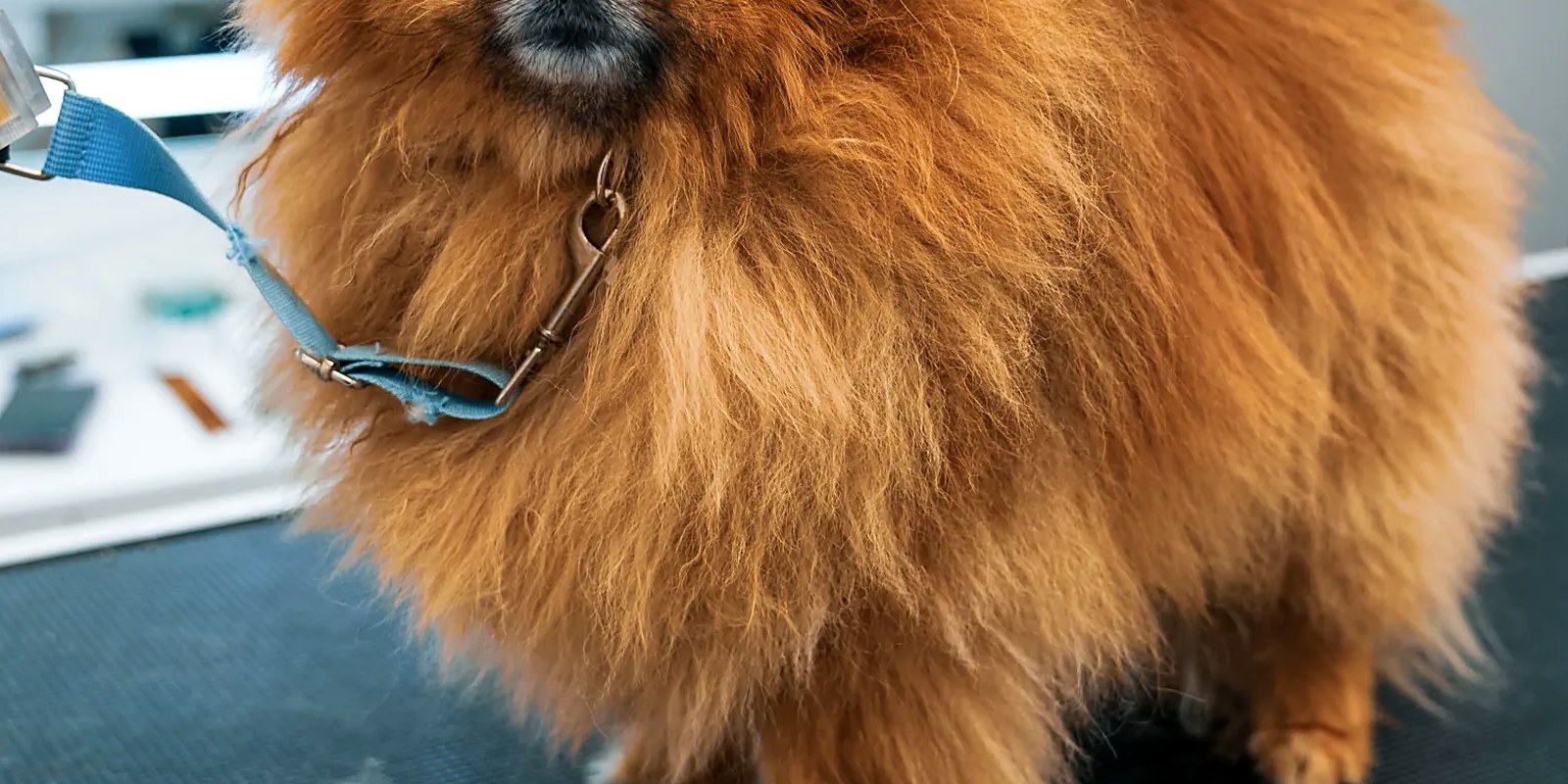
A double-coated dog wears two things at once. The outer layer is guard hair: longer, coarser, water-shedding, the part that carries the color and the shine. Underneath is a dense, woolly undercoat that traps air against the skin — insulation in both directions, slowing heat getting out in the cold and getting in the rest of the year. If you want the full anatomy, we wrote it up in our guide to grooming double-coated dogs.
Here is the part that matters for booking. When a dog releases undercoat, it lets go at the root but stays put, held in place by the guard hair above it and packed in like stuffing. That is why it keeps coming and coming. You are not shedding a layer, you are unpacking one. Brushing at home mostly reaches what has already surfaced, so it feels like no progress — and the coat that stays trapped starts to felt, behind the ears, in the ruff, in the trousers, under a collar. Felted coat holds damp, and damp skin against wool is where trouble starts.
You do not need a calendar for this. The dog tells you. When the brush fills in two strokes and the hair on the floor is soft and pale rather than long and glossy, that is undercoat, and that is the appointment to make.
Which dogs this is for, and which it is not
A blow-out is the right service
- Huskies, malamutes, Samoyeds
- German shepherds, Australian shepherds
- Labs, goldens, Bernese, Newfoundlands
- Corgis, shelties, chows, Pomeranians
- Any mix with a soft, dense layer under a coarser top coat
A blow-out is not the answer
- Doodles, poodles, bichons — coats that tangle rather than shed, and need a haircut
- Shih tzus, maltese, yorkies — same story
- Smooth coats like beagles or boxers, which just need a bath
- Any dog already matted to the skin: mats come first
If you have a doodle, your dog is not unloading undercoat, it is tangling. Different problem, different appointment — start with the doodle grooming guide instead. And if the shedding is general rather than a packed undercoat, our notes on managing shedding at home cover the brush-and-diet side of it.
Why we do not shave a double coat
It is the most tempting idea in dog ownership, and the one we push back on most often. Shaving takes off the guard hair — the part that is not the problem — and leaves the undercoat, which is. Owners are usually surprised the dog still sheds afterwards, just shorter hair, harder to see and harder to get off fabric.
Guard hair is the dog's barrier against sun and insects and its defense against getting soaked to the skin. Take it off and you have not cooled the dog down; you have removed its shade and left the wool.
Then there is regrowth. On many double coats the undercoat returns faster than the guard hair, so the dog comes back woolly and dull, sometimes patchy, sometimes with a texture that mats more easily than it did before.
Shaving does not stop the shedding. It just makes the hair too short to notice until it is in your carpet.
The exception is welfare. If a coat is pelted — matted solid so a comb cannot pass — brushing it out means hours of pulling on a sore dog, and clipping is the kinder call. That is a conversation we have with you at drop-off. You should never find out your dog was shaved by looking at the dog.
What a blow-out involves
Hands on first
Behind the ears, armpits, trousers, tail base, collar line — finding where the coat is packed, and whether anything is past brushing, before the dog gets wet.
Bath, worked to the skin
Shampoo and conditioner have to reach the skin, because that is where the loose hair is anchored, and conditioner lets packed undercoat release instead of tearing. Then rinse until it runs clear.
The blow-out
A high-velocity dryer drives air down through the coat, separating the layers and pushing dead undercoat out while the hair is still damp. This is the part you cannot copy at home with a brush.
Rake, brush, finish
A rake and slicker take out whatever the air loosened but did not carry off. Then nails, ears, and a last pass over the friction points where mats start.
How long to allow. Longer than a bath on a short-coated dog, and it varies more by coat than by breed — two shepherds the same weight can be an hour apart. Ask for an estimate when you book, and say if your dog is heavy in coat. Dogs who dislike the dryer get it in stages, which adds time again.
Booking it, and what it costs
De-shedding sits inside the bath work rather than being a haircut, so the service to look at is Bath & Brush. If your dog also needs length taken off, that is the full groom.
| Service | Price range | Best for |
|---|---|---|
| Bath & Brush | $45–$125 by weight | Double coats unloading undercoat, no haircut needed |
| Full groom with haircut | $85–$165 by weight | Coats that need cutting or shaping as well as washing |
Both are priced by weight, smallest to largest, and the bands sit on the grooming page next to the booking. That combination is unusual around here. Of eighteen Long Island salons audited from their own websites, only three publish any pricing at all and only seven let you book online — and in the Huntington, East Northport and Commack area specifically, the businesses we could find publishing ranges and taking instant bookings were mostly mobile services rather than fixed salons. If you have been calling around for a number and getting "bring the dog in and we'll see," that is why.
16 Laurel Rd, in the hamlet of East Northport in the Town of Huntington — a few doors along the same road as two other grooming businesses, so check the number. Tuesday to Saturday, 9 to 5, closed Sunday and Monday. Grooming only at this location: no daycare, no boarding. If Sunday or Monday is genuinely your only option, our Ronkonkoma salon is open seven days — separate location, so book that one directly. More on this salon on the East Northport page.
After the blow-out, you can finally see skin
This is the underrated part. A dog packed with undercoat is a dog you cannot check properly; after a de-shed you can run your hands over the whole animal in two minutes and actually feel what is there.
New York State splits its deer-tick surveillance into two fixed windows — nymphs May to September, adults October to December. In 2025, Suffolk County nymph density ran about 61 ticks per 1,000 square meters, with 26.6% carrying the bacterium that causes Lyme; among the adults collected later in the year, 52.8% tested positive. Suffolk is not the worst county in the state for tick density, but those are not small numbers for a dog that walks here. And a dog that spends its afternoons at the Town of Huntington's off-leash run on Deposit Road — the same ZIP as the salon — comes home with grass seed, burrs and dirt packed down into the undercoat where you will never find them by looking.
If we find an attached tick we will tell you and show you where, and then it is a vet question, not ours. Same for any lump, hot spot, or ear that smells wrong. We spot things; your vet diagnoses them.
Questions people actually ask
Will this stop my dog shedding?
No, and be wary of anyone who says it will. It takes out the dead undercoat that was coming out anyway, in one session instead of over weeks on your furniture.
How often should we do it?
It depends on the coat and on how much brushing happens at home. If your own brush-outs are keeping the undercoat moving and you can get a comb to the skin, you may not need to book anything right now — and we would rather say so than sell you a service.
Can I do this myself?
Partly. A rake and a slicker, on a dry, unmatted coat, in short sessions, do more than people think. What is hard to reproduce at home is the forced-air stage that reaches the packed layer near the skin. Do not attack a packed coat hard — you will pull skin, and the dog will remember it.
Is this different from a regular bath?
It is the same Bath & Brush service, done with the coat as the point of it: conditioner worked right to the skin, a long forced-air stage, then raking. On a heavy coat it simply takes longer, which is worth saying when you book.
My last groomer shaved my dog without asking. What now?
Bring the dog in and let us look at the regrowth before deciding anything. On a shaved double coat it can come back woolly or uneven for a long stretch, and the plan is usually to leave it be, keep the undercoat moving and let the guard hair catch up.
Do I need an appointment?
Yes, everything is by appointment, booked online on the grooming page with the pricing beside it. We are closed Sunday and Monday.
Get the undercoat out properly.
Check the price for your dog's weight, pick a time, and bring the coat in before it felts.
See pricing & book ›16 Laurel Rd, East Northport, NY 11731 · Tue–Sat 9–5
Ready to Pamper Your Pet?
Book a grooming appointment today and give your furry friend the spa treatment they deserve.
Book an Appointment