
The Autumn Coat Change: What Your Dog's Undercoat Does in Fall
Lillian Ruff Pet Spa
Spring gets all the attention for shedding, but if your dog carries an undercoat, autumn is the other half of the year when hair comes out in handfuls. Here is what happens under the top coat, which dogs go through it, and when a de-shedding bath is worth booking.
Yes, plenty of dogs shed in fall. Double-coated dogs release the summer undercoat while a denser winter one comes in underneath. Single-coated and curly-coated dogs barely change, and for them a de-shed is the wrong thing to book.
The fall coat change, in plain terms
A double-coated dog wears two garments. The outer layer is guard hair: coarse, weather-facing, slow to turn over. Underneath sits the undercoat, soft and crimped and packed close to the skin. That is the insulation, and the layer that changes.
When it turns over, the loose undercoat does not fall to the floor. Most of it stays caught in the guard hair, packing down against the skin into a dense, felted layer. That is why a dog can look fine from above and still leave drifts of hair on the sofa, and why brushing the surface changes nothing. You are combing the roof; the problem is in the attic.
There is no date on the calendar for it. Two shepherds on the same street can turn over weeks apart, and a dog who lives indoors year-round often sheds steadily rather than in waves. If yours has never done a dramatic autumn shed, nothing is wrong.
Signs it is a normal coat change
- Undercoat lifts out in soft tufts, cleanly and painlessly
- A comb run to the skin comes back holding fluff
- The coat looks hazy or dusty rather than sleek
- Volume rises for a stretch, then settles back down on its own
Signs to call your vet, not a groomer
- Bald patches, or thinning even on both sides
- Red, flaky or smelly skin under the coat
- Scabs, hot spots, or scratching that breaks skin
- A sudden change in coat texture or color
We will tell you what we find, but groomers are not diagnosticians: the right-hand list belongs with a vet.
Which coats change, and which barely do
| Coat type | What autumn looks like | What helps |
|---|---|---|
| Double coat — shepherd, husky, golden and Labrador retriever, corgi, Pomeranian, Aussie | The big one. Undercoat releases and packs into the guard hair. | De-shedding bath and blow-out; undercoat rake at home. |
| Short smooth coat — boxer, smooth dachshund, bully-type mixes | Low-level shedding all year, little seasonal change. | A rubber curry and a bath. A de-shed is wasted on them. |
| Curly and wool — poodle, goldendoodle, bichon | Shed hair stays in the curl and becomes matting. | Line brushing to the skin and a haircut on schedule. Not a de-shed. |
| Silky coat — shih tzu, maltese, yorkie | Hair grows continuously rather than cycling. | Combing and trims on the usual schedule. |
Brushing more while the coat turns over, and which tool does what
Short and frequent beats long and occasional: the coat keeps releasing all week while you wait for Sunday.
Work in sections rather than in sweeps. Start low — the back of a thigh, the bottom of a flank — lift the coat ahead of the brush with your free hand, and work the strip you can see skin under before moving up. Ten minutes done that way clears more than half an hour of brushing over the top of an undisturbed coat, and it is far more comfortable for the dog because nothing is being dragged through a packed layer.
Bladed de-shedding tools work and are easy to overuse. Repeated passes over one spot, or pressure on a dry coat, cut guard hair and leave skin sore. Use them briefly, on a coat already brushed through.
What a de-shedding bath and blow-out actually removes
Rough out first
Loose coat is worked out dry, so the bath reaches skin instead of soaking a packed layer of fluff.
Bath, worked to the skin
Shampoo and conditioner go all the way down and sit, loosening the undercoat's grip.
High-velocity blow-out
Where most of the coat comes off. Moving air separates the guard hair and drives loose undercoat out from the skin.
Rake, comb, check
A last pass through the ruff, hindquarters, tail base and ears, then a comb test to prove it is clear.
Most of the work in that list is step three, and it is the part that is genuinely hard to reproduce at home. A high-velocity dryer moves air rather than heat, and it pushes coat outward from the skin in a way no hand tool does. It is also loud, so a dog meeting one for the first time gets introduced to it gradually rather than held in front of it — and if a dog says no, we work around the ruff and the hindquarters by hand instead.
A de-shed does not stop a dog shedding. It moves hair that was going to come out on your floor into one appointment.
When a de-shed is right, and when it is not
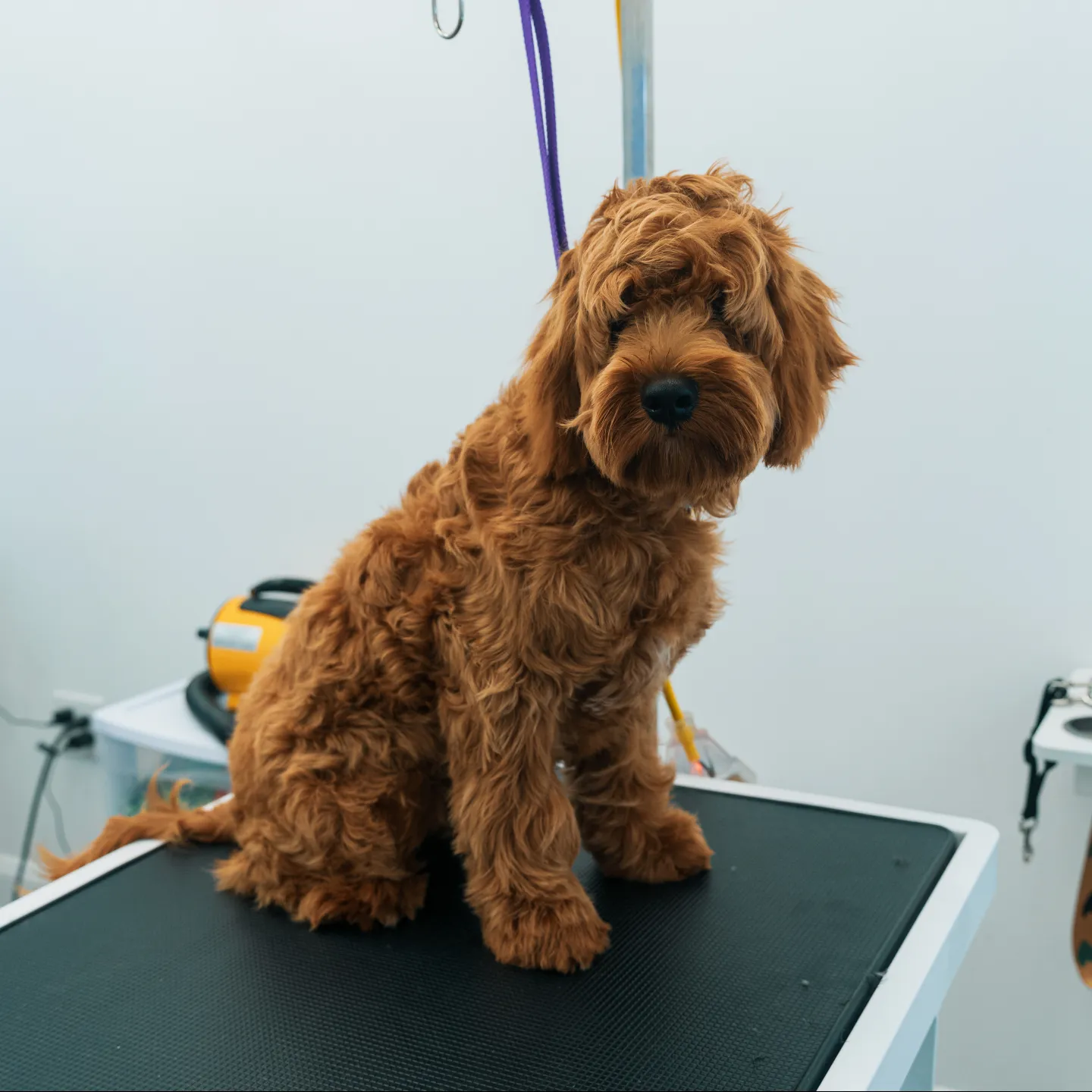
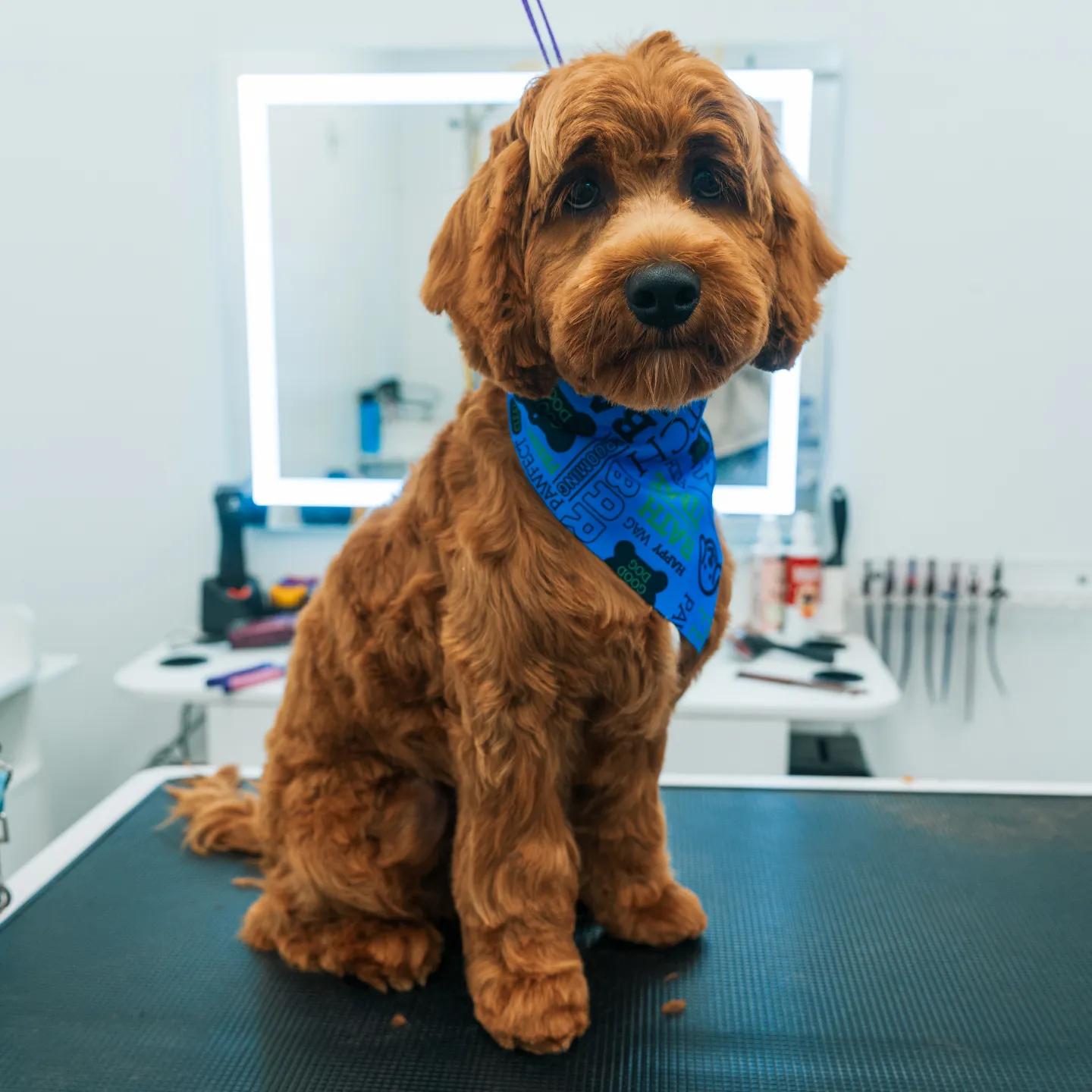
If a coat is matted, a de-shedding bath is the wrong service: water tightens matting rather than loosening it. Mats come out with clippers, and we agree the length with you first. On a doodle, what looks like shedding is hair trapped in the curl on its way to a mat — brushwork and a haircut, not a rake.
Shaving a double coat is not a shedding fix either. A shaved dog still sheds, you just get shorter hair on the floor, and the layer that insulates in both directions is gone. If there is a medical reason to remove a coat, make that call with your vet.
Autumn here, practically speaking
The Town of Huntington runs a free-permit off-leash dog run at the Animal Shelter on Deposit Road, here in East Northport, open weekdays 8am to 6pm and weekends 9am to 4pm. Town parks are otherwise on-leash, six feet or shorter, and dogs stay off town beaches except paved areas and boardwalks.
Autumn dogs here spend real time in leaf litter and long grass, and tick season does not end with summer. New York State splits deer-tick surveillance into nymphs from May to September and adults from October to December, and in Suffolk County in 2025, 52.8 percent of the adults collected in that later window carried the bacterium that causes Lyme disease — roughly double the nymph rate. That is no reason on its own to book a groom. It is a reason to get hands and a comb over every inch of the dog, which is what a de-shed involves anyway. If we find something attached we tell you, and you call your vet.
At Islip, our nearest official weather station, the average daily low is below freezing from December through February. The coat arriving now is the one that does that work, and clearing out the dead layer is what lets it come in properly.
Booking an autumn groom at 16 Laurel Rd
Our published prices go by weight, smallest to largest. A bath and brush runs $45 to $125. A full groom with a haircut runs $85 to $165. Where a de-shedding bath and blow-out lands is worth checking on the booking page before you commit, because a heavy double coat is more work than a smooth coat of the same weight and you should see the number rather than guess at it.
Being able to see a number at all is rarer around here than it should be: of eighteen Long Island salons audited from their own websites, only seven offered online booking and only three published any pricing. You can see pricing and book online at any hour, including the evenings and the two days we are closed. If you are not sure which service fits your dog's coat, get in touch and describe it — breed, rough weight, when it was last done — and we will tell you which one to pick.
The East Northport salon is open Tuesday through Saturday, 9am to 5pm — grooming only, no daycare or boarding, and no cats.
And if your dog is short and smooth-coated, you probably do not need us for shedding at all. A rubber curry a few times a week beats any appointment. Book when there is a coat to move.
Questions people actually ask
Do dogs really shed in the fall, or is that a spring thing?
Both, if your dog carries an undercoat. Spring is more famous, but the autumn turnover can be just as heavy. Single-coated dogs shed at a low level year-round and do neither dramatically.
How often should I brush during a coat change?
Little and often — ten minutes most days. The test is whether a metal comb travels from skin to tip everywhere, including the ruff, armpits and back of the thighs.
Will a de-shedding bath stop the shedding?
No, and be wary of anyone who says it will. It removes hair that is already loose, so far less comes out at home afterwards. The cycle carries on regardless.
What does it cost?
Bath and brush is $45 to $125 depending on your dog's weight, and a full groom with a haircut is $85 to $165. For a de-shedding bath and blow-out specifically, check what it lists at on the booking page before you confirm — the price is there to read rather than something you find out at pickup.
My dog hates the dryer. Is a de-shed still worth it?
Often, yes, but tell us in advance. Plenty of the work — the rough-out, the bath, the raking and combing — happens without a high-velocity dryer at all, and a dog who will not tolerate one still leaves with a lot less loose coat than they arrived with.
Are you open Sundays for this?
East Northport is Tuesday to Saturday, 9am to 5pm, closed Sunday and Monday. Our Ronkonkoma salon, a short drive away, is open seven days if a Sunday is the only day that works.
Get the dead coat out before the winter one settles in.
Pick a time online and see the price before you commit.
See pricing & book ›16 Laurel Rd, East Northport, NY 11731 · Tue–Sat 9–5
Ready to Pamper Your Pet?
Book a grooming appointment today and give your furry friend the spa treatment they deserve.
Book an Appointment